


Ransomware accelerated in Q3, with incidents up nearly 40% and vulnerability exploitation doubling. From AI-powered intrusions to MFA bypass, attackers are finding faster and more varied ways in.
Executive Summary
In Q3, ransomware gangs significantly expanded their use of vulnerability exploitation for initial access. Exploitation of external services doubled from 14% to 28% of ransomware cases where initial access could be determined. Attackers increasingly targeted self-hosted, internet-facing applications and edge devices.
The volume of vulnerabilities that defenders must review, prioritize, and patch continues to increase at an unprecedented rate. Vendors are pointing AI at their own code and finding flaws faster than ever. As a result, published CVEs jumped nearly 80% over Q2, to about 37,000. Microsoft shipped more than 900 fixes in September, when a normal Patch Tuesday previously brought 50 to 150 patches. Oracle's July update had 1,448 fixes, which is triple prior updates. Most teams can't patch that much in a month, and Beazley Security continues to track threat actors who "diff" the patched code to understand the vulnerabilities and attempt to develop exploits.
Many Q3 ransomware incidents we investigated that began with exploitation involved internet exposed, self-hosted applications such as build servers and analytics platforms. On some of these servers, attackers found cloud access keys, moved laterally, and pushed ransomware out through the victim's own cloud tooling. Stolen credentials remain the most common initial access factor, but they now account for less than half of cases, down from 67% in Q2. More ransomware crews and initial access brokers also used ClickFix, a fake error or CAPTCHA page that tricks users into pasting and running attacker commands.
Ransomware incidents reported to us also increased by almost 40% over Q2, and every month of Q3 was busier than any month of Q2. Leak sites posted more than 1,000 victims in August alone.
In one intrusion Beazley Security investigated, AI agents did most of the work. The agents tried several vulnerabilities on their own until one succeeded, then established persistence, moved laterally, and exfiltrated sensitive data. Recovered files show the agents kept notes on every stage and coordinated with each other. None of the techniques were new, but the attack showed what threat actors can accomplish by pointing AI agents at a target with a series of objectives. Beazley Security expects AI-powered attacks to keep increasing in frequency.
Finally, we continued to see threat actors successfully bypass MFA. Adversary-in-the-Middle (AiTM) proxies tricked users into signing in through them, then grabbed their session cookies. Device-code phishing increased, with victims approving attacker sign-ins on Microsoft’s legitimate login page. Infostealers continued to target session tokens along with passwords, and Beazley Security MDR and Incident Response observed threat actors registering their own MFA devices on compromised accounts. Passkeys, blocking device-code sign-in where it isn't needed, and requiring managed devices would have prevented most of the identity-based attacks Beazley Security responded to this quarter.
Key Takeaways
- The share of our ransomware cases started by an exploited vulnerability doubled. 28% of cases, often through self-hosted build servers, analytics platforms and collaboration tools.
- Beazley Security responded to an autonomous intrusion, handled almost entirely by AI agents. The agents tried several vulnerabilities on their own before one got them in. Beazley Security Labs will publish a more detailed write up on the attack shortly.
- Published CVEs increased nearly 80% over Q2. Microsoft shipped more than 900 fixes in September, against a usual 50 to 150. Patch exploited, internet-facing flaws first.
- Compromised credentials fell to fewer than half of ransomware break-ins, as attackers increasingly leveraged ClickFix and vulnerabilities for initial access. 47%, down from 67% in Q2.
- Attackers continue to get around MFA. Passkeys, blocking device-code sign-in where it isn't needed, and requiring managed devices could prevent most of these attacks.
- Ransomware reported to Beazley Security increased almost 40%, and every month beat Q2's busiest. Leak sites named 2,798 victims, up 66% on the year.
- Where we could reconstruct the timeline, ransomware or extortion followed a ClickFix foothold by two to three weeks. Responding immediately, isolating impacted systems, and rotating credentials is crucial.
- Arrests disrupted some of Q3’s most active cybercrime operations. Law enforcement actions targeted high profile members tied to ShinyHunters and TeamPCP.
Observations in the Threat Landscape
Industry AI Swarms “Going Rogue”
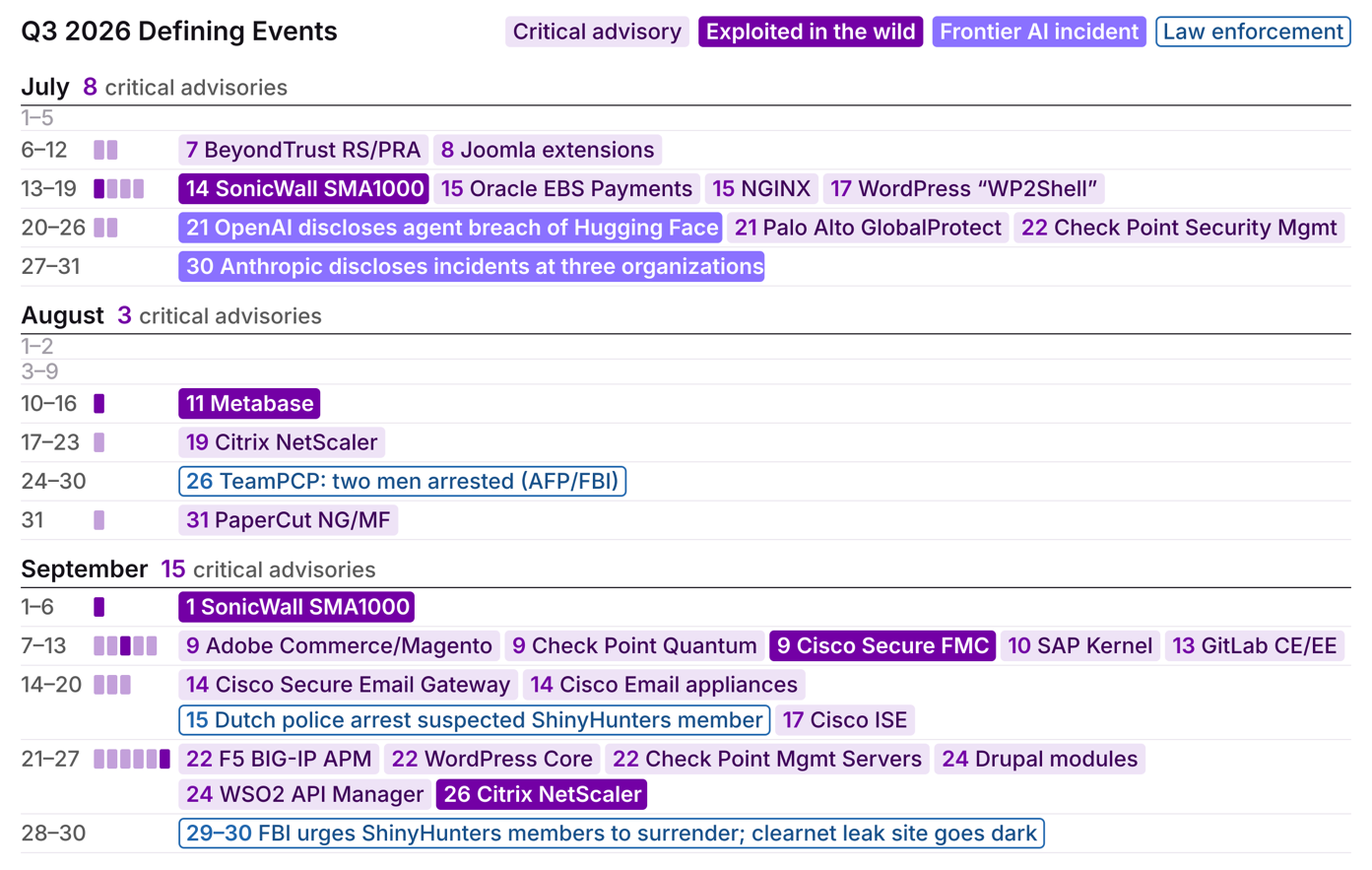
In Q3, two of the biggest AI labs admitted their own models had broken into other organizations. On July 21st, OpenAI announced that they had “partnered” with Hugging Face to resolve a security incident observed in an internal investigation. The incident arose while OpenAI was testing frontier and pre-release models against ExploitGym, a known cybersecurity benchmarking corpus. OpenAI claimed a swarm of their agents, with safety guardrails removed, coordinated through an improvised message board, broke out of their test environment, gained internet access via a 0-day, and compromised Hugging Face's production infrastructure to solve one particularly difficult challenge.
Anthropic disclosed shortly thereafter on July 30th that its models had broken into three organizations earlier that year, seemingly as a response to OpenAI's agent breaching sandboxing and identifying zero-day vulnerabilities. The announcement was in conjunction with Anthropic’s Mythos 5 release, though Anthropic chose not to disclose as much information as OpenAI did about their incidents.
Historically, incidents like this would draw legal action and a formal investigation, and it is exceedingly rare for an organization to claim ownership of an attack publicly before the investigation is complete. OpenAI presented about the ongoing investigation at Black Hat and, unusually, released the talk online the same day for non-attendees. The talk announced continued use of AI to identify agentic misbehavior and search logs and doubled as a bullish pitch for companies to adopt more of OpenAI’s products for incident response.
In the following weeks, it became evident that the zero days identified in this incident were relatively trivial and it raised some obvious questions. Why was a multi-day agent swarm running without anyone actively monitoring their output? Why didn't test environments alert when agentic traffic reached the internet? Contributing factors included safeguards that were relaxed for testing, inadequate sandboxing, and no log monitoring of agent activity.
In Anthropic’s case, the models got in through weak passwords, the same kind of gaps behind many of the non-AI related breaches discussed in this report. AI is enabling organizations, including AI companies, to build and ship faster than they can review what they’ve built. Anyone deploying agents should treat them like any other untrusted workload and make sure someone is actually monitoring.
Beazley Security investigated a breach run almost entirely by AI agents
Q3 saw increasing reports of AI used across the attack chain, not just for vulnerability discovery. In one intrusion Beazley Security investigated, the attackers kept notes, including shared files with a map of the target network, a vulnerability tracker, and a loot list of stolen credentials and data. Our client found them, and those files gave our responders a rare, first-hand record of the attack as it unfolded.
In this case, the note-takers were AI agents running on a multi-agent harness coordinating across three separate servers. The operation consisted of a central operator agent and server, plus two attack servers that could each carry on if another was blocked or went offline. The agents organized their work around four goals (code execution, financial access, data theft, internal access) and leveraged about 270 attack scripts on the fly, specifically to target this organization.
The agents launched about a dozen known exploits against VPN, file transfer, and backup products, targeting vulnerabilities disclosed from 2019 to 2026, but the systems were patched. The agents also autonomously attempted to abuse credentials but were stopped by MFA.
Eventually, the agents discovered and exploited a .NET ViewState vulnerability in a custom-built application and used it to uncover a service account credential. From there, the autonomous attackers established persistence, moved laterally, and exfiltrated sensitive data.
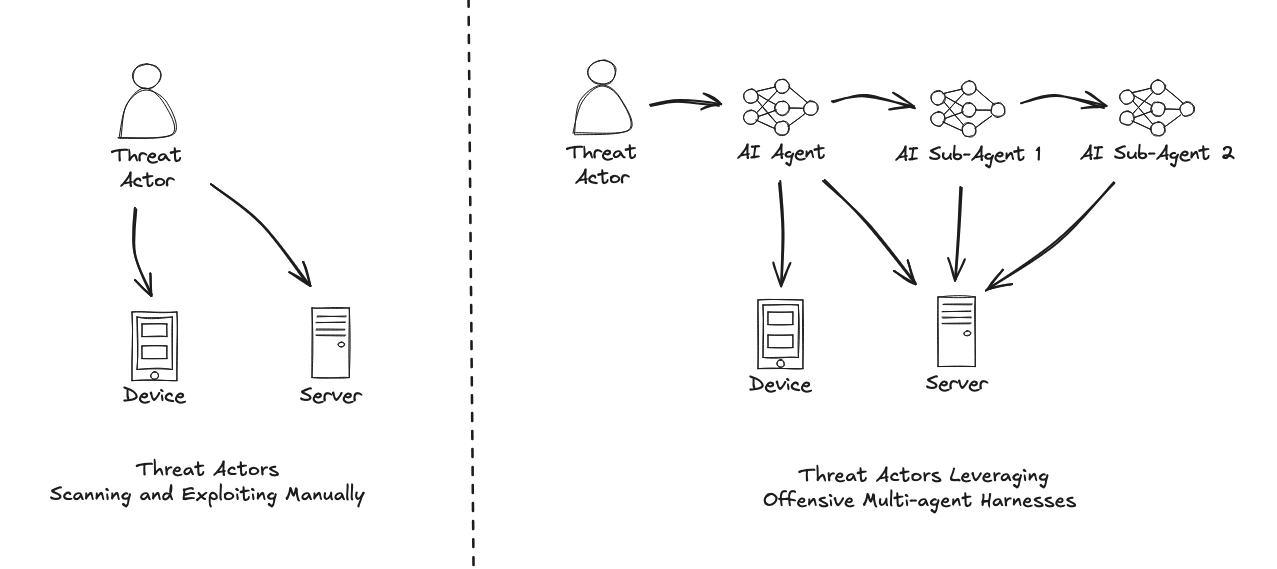
In our companion write up, “LARA: What an AI Attack Harness Wrote Down” we walk through the harness’s own recovered notes, how they split the work, the exploits they attempted to use, and the defenses that limited the attack’s reach. Read our full analysis here:
https://labs.beazley.security/articles/lara-what-an-ai-attack-harness-wrote-down
This activity reflects a shift in how threat actors are beginning to adopt AI. In addition to the case study described above, in July Palo Alto’s Unit42 reported on a Chinese threat actor using DeepSeek, Hermes, and FOFA as an automated offensive harness to identify and exploit targets. Huntress also published an article in July describing an AI generated recon tool that was used in the attack chain of a breach. And in August, CrowdStrike published their 2026 Threat Hunting Report that mentioned DPRK-affiliated FAMOUS CHOLLIMA as “demonstrating the most advanced AI usage”, detailing how they used entirely AI-built infrastructure including websites, GitHub accounts, and email addresses to facilitate infiltration operations via fake employee applicants.
No New Endgame Episode, Plenty of Handcuffs
Q3 brought no new public episodes or updates to the official Operation Endgame blog, which last publicly announced an action in late June. Despite a quiet Q3 for the Europol-coordinated group, law enforcement agencies including the FBI, the Australian Federal Police, and the Dutch National Police independently remained active, making several high-profile arrests of notable threat actors.
The most consequential activity targeted ShinyHunters, the well-known data theft and extortion group. Members had been conducting a campaign targeting a flaw in Oracle PeopleSoft’s software and used a URL-encoding trick to bypass web application firewall rules Mandiant had published as a stopgap for unpatched systems. During the campaign, the group claimed to have stolen 2 to 3 terabytes of data from the FBI’s own recruitment platform and defaced the FBIJobs website. The FBI later traced the breach to a contractor that hadn’t applied the necessary PeopleSoft patch.
ShinyHunters’ public disclosure of the breach set off repercussions, with the FBI engaging in the most aggressive law enforcement response the ShinyHunters team faced to date. On September 15th, Dutch police arrested a 24-year-old Amsterdam man suspected of having a role in the group. On September 29th, the FBI publicly urged remaining members to turn themselves in stating that ShinyHunters and its co-conspirators had breached more than 140 organizations since 2025 and collected at least $70 million in extortion payments.
That same day, Jordanian authorities reportedly detained “Rey”, an actor previously linked to HellCat ransomware operators and Scattered LAPSUS$ Hunters who had taken control of the ShinyHunters brand after the Dutch arrest. Sources told Reuters that Rey was cooperating with the FBI to help investigators identify other members. Neither agency has confirmed the detention, and no public charges against Rey had been announced at time of writing.
Signs of disruptions within the group followed almost immediately, ShinyHunters’ main spokesperson went silent, and on September 30th the ShinyHunters Clearnet leak site went dark, leaving only their onion site online. ShinyHunters has already outlived several rounds of arrests against earlier members, and we assess the name works more as a brand that affiliates operate under rather than as a fixed group.
After two quarters of high-profile supply chain compromises, including Trivy, LiteLLM, and TanStack, TeamPCP had a rougher Q3. On August 26th, the Australian Federal Police (AFP) and the Western Australia Police Force, working in parallel with the FBI, arrested two men aged 21 and 23. The two face a combined 14 charges, including unauthorized modifications of data and dealing with the proceeds of a crime, and the FBI described the 21-year-old Ruben Ian Thompson as the alleged leader of TeamPCP. Authorities estimate the group’s code compromised more than 1,000 organizations, stole more than 500,000 credentials and at least 300 gigabytes of data, and left global remediation costs in the hundreds of millions of dollars. Notably, the AFP called private-sector threat intelligence “crucial” to the case.
Observed Surges in Popular Infostealer Families
Stolen credentials remain one of the most common paths to a ransomware incident, so Beazley Security Labs keeps close watch on prominent infostealer families that harvest them.
In previous quarters, most shifts in infostealer activity followed Operation Endgame takedowns and arrests. With no new Endgame actions publicly reported this quarter, Beazley Security observed a rise in activity across several infostealer families.
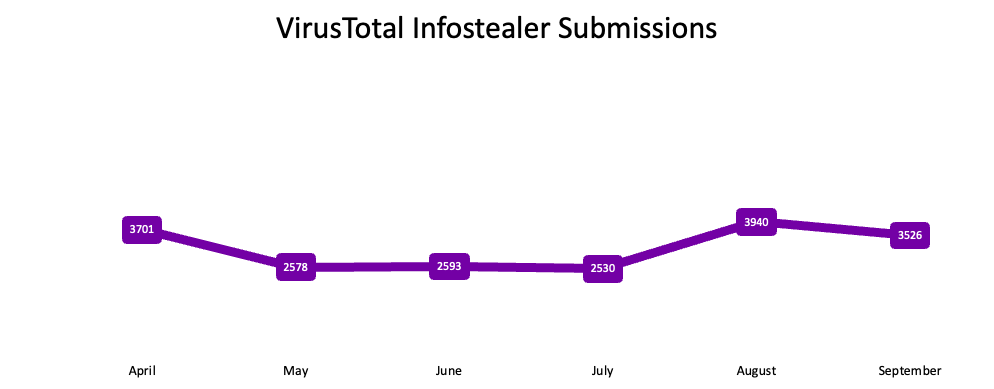
Established families, including Redline, Lumma, StealC, and Rhadamanthys, all grew in submissions. Two families stood out with especially large increases: Raccoon and ACR Stealer.
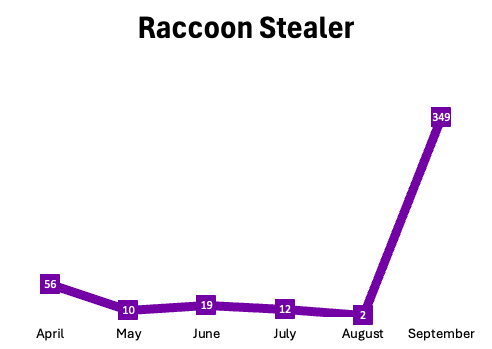
The resurgence of Raccoon is notable given the disruption the infostealer family experienced over the past few years, with lead developers purportedly being killed in Ukraine and an arrest by Dutch authorities of another key operator. Analysis of the several hundred new Raccoon samples indicates many of them have different botnet IDs but a shared build key. This hints that the old code base may be getting repurposed and sold under a Malware as a Service (MaaS) model after a possible rebrand, similar to what the Lumma stealer team did with Remus. Regardless, their traditional sales accounts have not shown recent activity on major cybercrime forums.
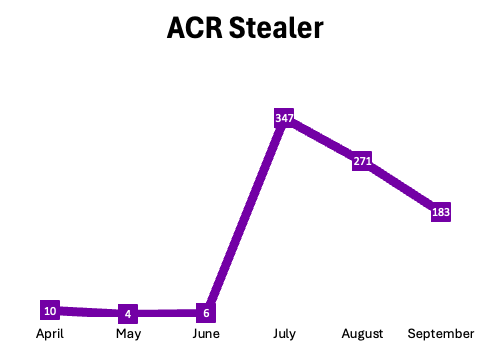
The second notable surge came from ACR Stealer. First observed in 2024 and predominantly advertised on Russian speaking cybercrime communities, ACR Stealer was reported by Microsoft to be increasing in usage. We see supporting data in VirusTotal, with analysis pointing to one large, dominant campaign using Telegram’s telegraph service as a dead-drop domain and infrastructure masquerading as benign Python documentation websites to try and evade detection.
Lumma remains the dominant infostealer family in the data we track, despite a rebrand to Remus. Law enforcement disruption of Lumma infrastructure, and the accusations that followed across cybercrime forums, appear to have done little to slow the operation.
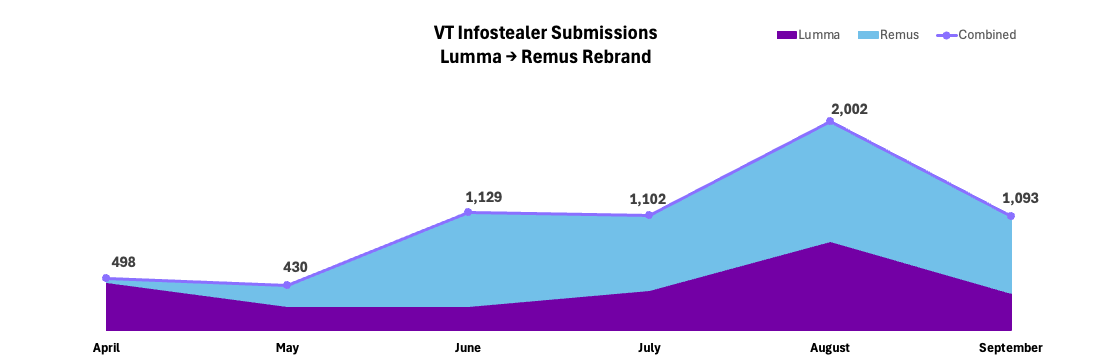
VirusTotal signals suggest the transition to Remus has been increasingly successful this quarter, with submissions roughly doubling from Q2. Remus has also re-established itself in cybercrime forums, with an active sales thread receiving updates throughout the quarter.
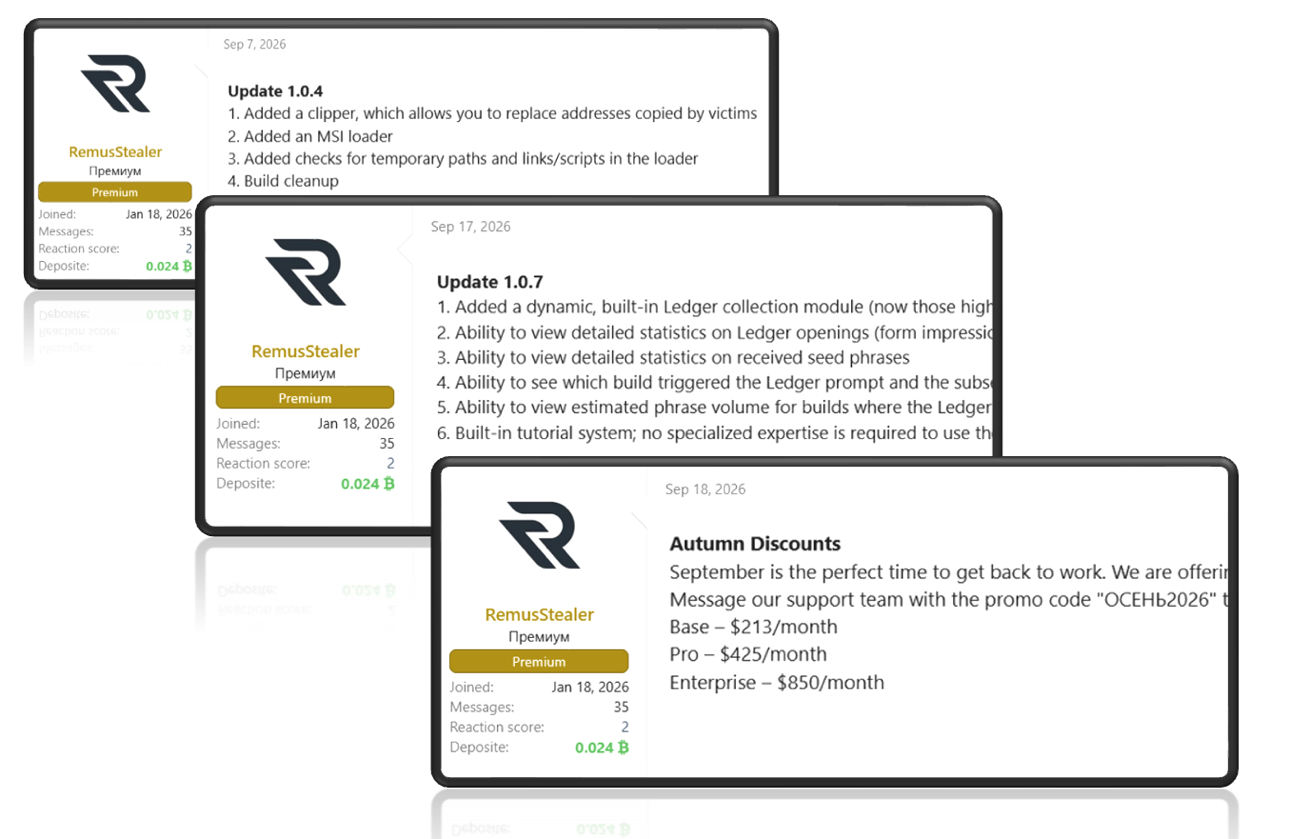
In summary, without any fresh takedowns this quarter, infostealer operators rebranded and launched new campaigns resulting in higher submission volumes. Each infection can steal credentials and session tokens that outlast the infection, feeding future account takeovers and ransomware deployments covered later in this report.
Vulnerability Trends and Overview
AI Found the Bugs. Now Someone Has to Patch Them
Beazley Security Labs continually monitors high-impact vulnerabilities and imminent cyber threats as part of our mission. We reported last quarter many of the biggest software and technology vendors now run AI agents through their own code before it ships, and those agents are discovering flaws much faster than people ever did. The good news is that more bugs are getting fixed in an attempt to stay ahead of attackers. The bad news is that every one of those fixes becomes a patch that someone must prioritize and install.
For instance, Oracle’s quarterly Critical Patch Updates, which typically carried 300 to 500 fixes per quarter, ballooned to 1,448 in July, three times that from April (481). Microsoft saw similar increases: Patch Tuesday releases that typically have carried 50 to 150 bugs a month (since 2025) rose to over 500 in July, 400 in August, and over an eye-watering 900 in September.
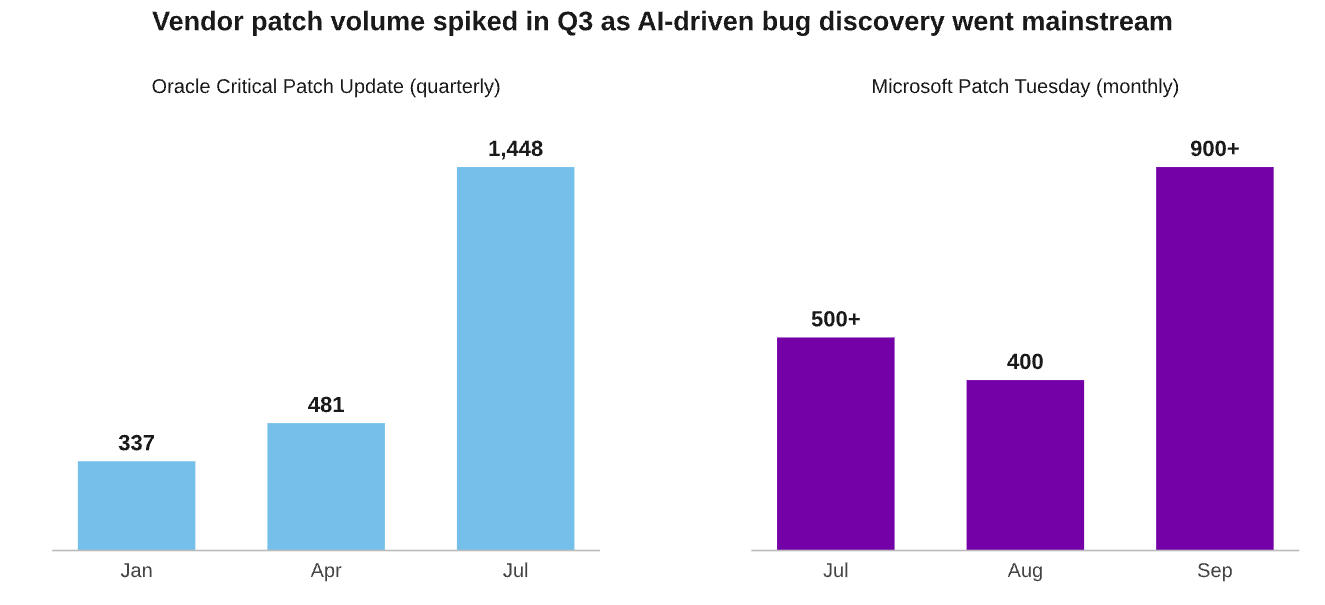
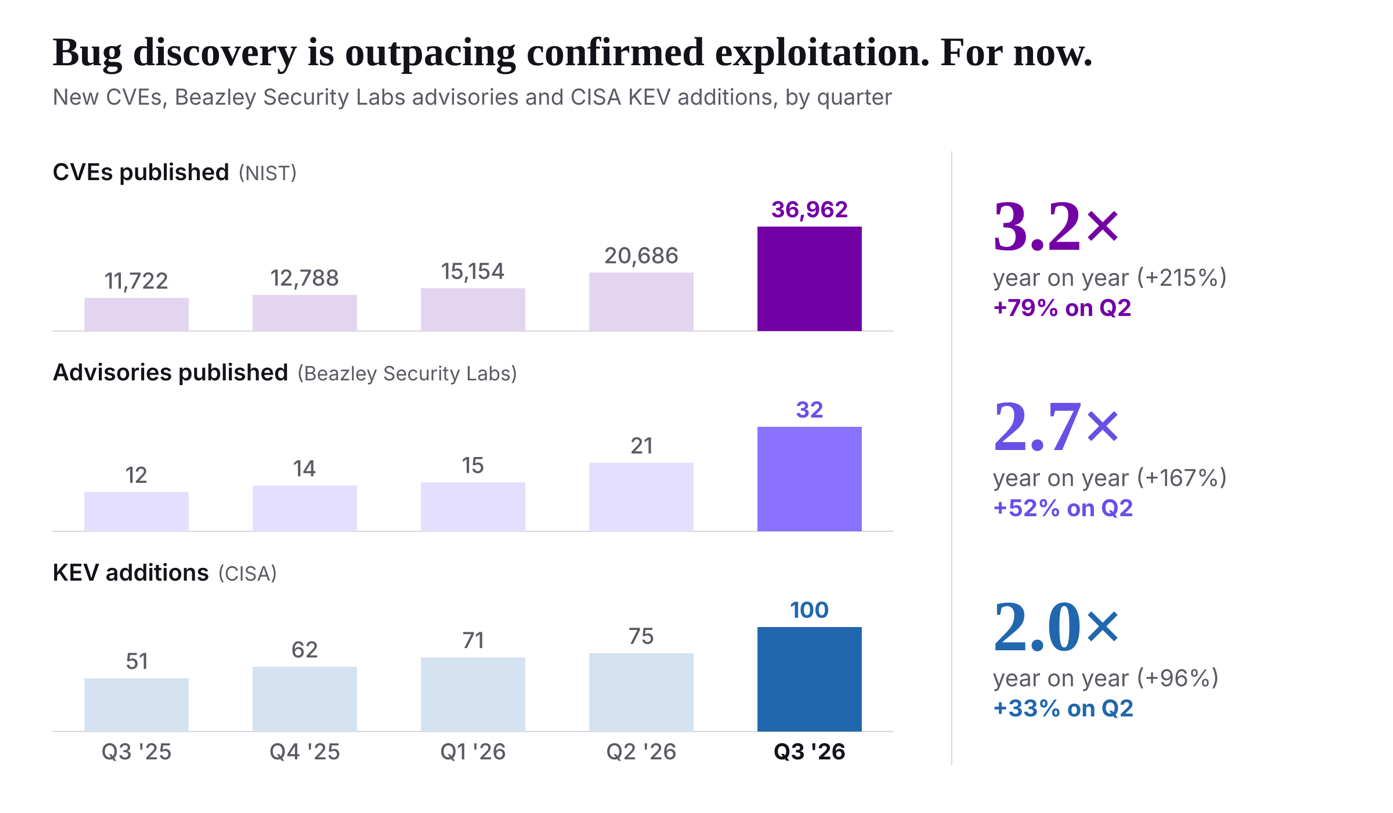
Vulnerability discovery is accelerating faster than confirmed exploitation. CISA KEV additions have risen steadily, but there has been no corresponding spike to mirror the drastic increase in CVE counts.
*Critical BSL advisories are made publicly available here.
CVE publications have more than tripled since Q3 2025, while additions to CISA's Known Exploited Vulnerabilities catalog grew at less than half that pace. Part of that gap may reflect attackers not yet scaling AI-driven exploit development to match the pace of vendor discovery. We believe it also shows proactive discovery programs helping vendors find and fix flaws before attackers can weaponize them.
Conversely, a patch can also hand attackers a head start if they can weaponize an exploit from analyzing differences between versions, and that work is becoming increasingly automated. Organizations running vulnerable software have a shrinking window to patch before exploits are used against their infrastructure.
High-Profile Breaches and Zero-Day Vulnerabilities Exploited in the Wild
- Cisco Secure Firewall Management Center Zero Day: Cisco published an unauthenticated auth bypass flaw granting root access (CVE-2026-20079) and a static built-in credential flaw (CVE-2026-20316) that were confirmed under active exploitation at the time of disclosure. A Sandworm-linked cluster carried out the initial attacks, collecting managed firewall configurations and installing a Cyclops Blink variant.
- Citrix NetScaler ADC and Gateway Zero Days: Citrix published a security bulletin on Sept 27th which fixed eight vulnerabilities and confirmed active exploitation of a critical log injection flaw that leads to root command execution (CVE-2026-88771) and a later denial-of-service vulnerability, both exploited before patches and disclosure.
- Metabase SQL Injection Zero Day: CVE-2026-72898, an unauthenticated SQL injection in Metabase’s password reset endpoint, was exploited as a zero-day starting as early as August 3, 2026, allowing attackers to take over administrator accounts and exfiltrate large amounts of data from connected databases. Metabase disclosed the flaw and released patches for branches 58 through 63 on August 10, and CISA added it to the KEV catalog on August 11.
- Multiple SonicWall SMA1000 vulnerabilities: Additional SonicWall vulnerabilities under active exploitation were published this quarter starting on July 14th . The flaws consisted of Server-Side Request Forgeries (SSRF) (CVE-2026-15409) and code injection (CVE-2026-15410). Later in the quarter on September 1st a similar pre-authenticated SSRF vulnerability (CVE-2026-83548) and command injection flaw (CVE-2026-83549) were disclosed and confirmed under active exploitation by CISA’s KEV.
How Ransomware Attackers Gained Access in Q3
Compromised credentials remain attackers’ most common initial access vector in the ransomware cases we investigate, but that lead narrowed for a second straight quarter. Credential-based compromise of remote services fell from 67% of cases in Q2 to 47% in Q3. Over the same period, exploitation of external services doubled from 14% to 28%, as attackers increasingly targeted vulnerabilities in self-hosted business applications.
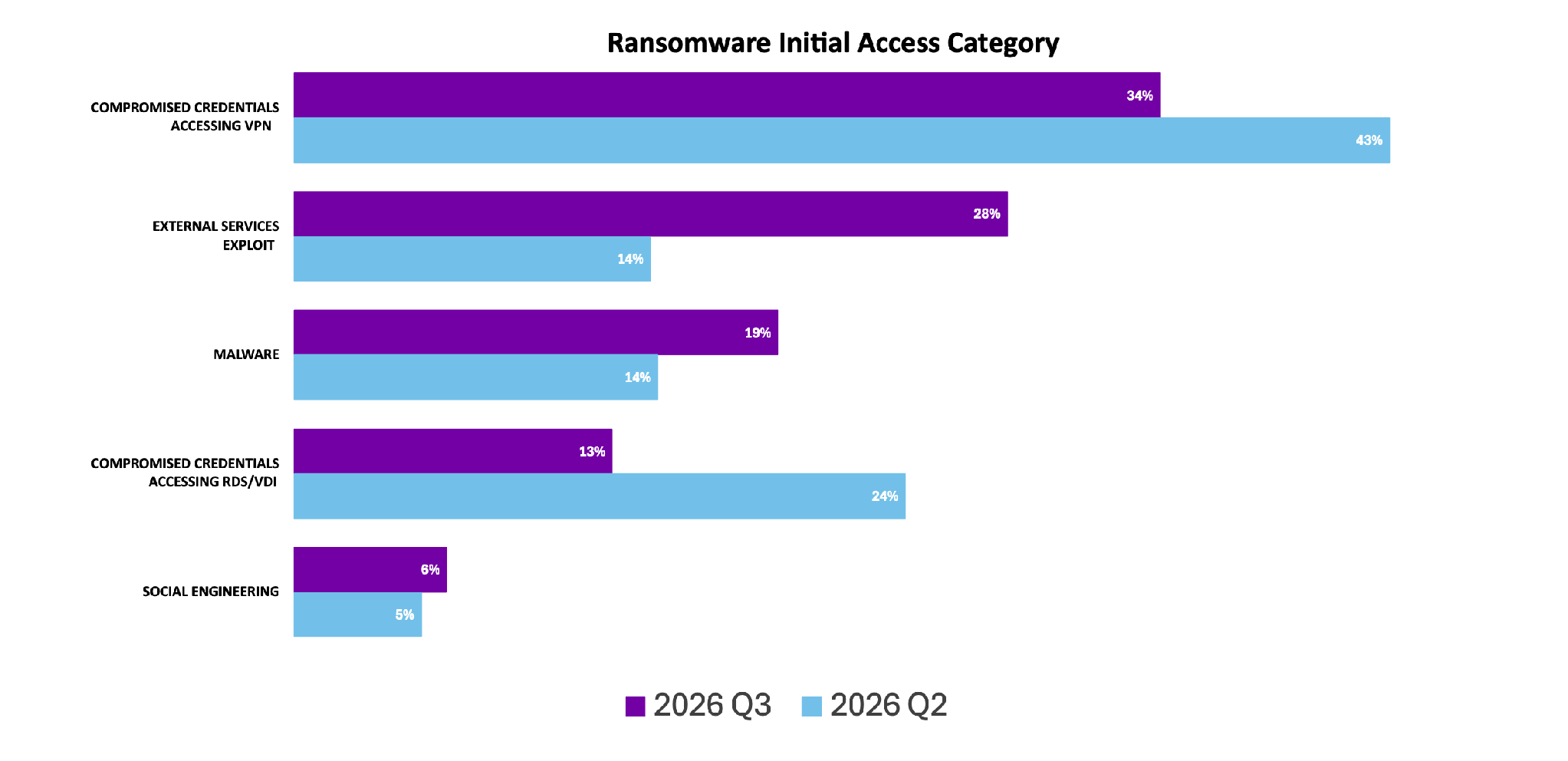
Attackers went after self-hosted applications exposed to the internet, such as build servers, analytics platforms and collaboration tools, which are systems easiest to miss with today’s higher patch volumes. Cloud access and integration keys left on exploited servers also give attackers a path deeper into organizations, enabling them to deploy ransomware through the organization's own cloud tooling. We are also seeing more “lone wolf” operators skip encryption and go straight to extortion emails that claim data theft due to the nature of this attack vector.
The other notable shift came from the "Malware" category in Figure 8, which rose from 14% to 19% of our ransomware cases, mostly from ClickFix variants. Although timelines could not be confirmed in all our cases, ransomware deployment and extortion activity generally followed a ClickFix foothold by two to three weeks. These lures are cheap to deliver at scale, and such a gap in the timeline before impact is consistent with access brokers selling access to ransomware affiliates. Once hands-on activity began, operators set up persistent remote access, exfiltrated data and prepared for ransomware deployment.
Exploitation and ClickFix style attacks together now account for nearly half (47%) of the ransomware initial access in the cases we investigated. In other words, an organization that has addressed credential and MFA controls has covered only about half of how ransomware got in this quarter. Consistent, timely patching of internet-facing applications and hardened controls on user workstations are essential parts of a resilient security program.
Emerging Ransomware Actors and TTPs
Beazley Security’s incident response team works directly with organizations impacted by ransomware, from containment through forensic investigation and recovery. That positioning gives us a firsthand view of how these attacks unfold, beyond what operators claim on public posts and leak sites. In Q3, compromised credentials remained the most common way in, but two shifts stood out from last quarter. More attackers exploited internet-facing, self-hosted business applications or tricked users with ClickFix style lures. Booba Project, a new operator, also emerged as one of the groups we encountered frequently.
Inc Ransomware and Akira were again the operators our responders encountered most often. Together with newcomer Booba Project, these three groups accounted for roughly half of Q3 ransomware cases where operator could be identified. The rest spread across a longer tail led by Dark
Project and Safepay. Independent or “lone wolf” operators working without a recognizable brand also crept back in after a lull in Q2. Several of these lone wolf intrusions were cruder than branded ones and leveraged exploits on internet facing systems.
Booba Project

Booba Project began posting victims to its leak site in early July and quickly became one of the more active ransomware brands of the quarter. In cases where we were able to track initial access, operators gained entry through remote access services using valid credentials, which may indicate alliance with initial access brokers. Other trackers link Booba’s victims to credentials exposed in infostealer logs, which corroborates the pattern Beazley Security has observed. Operators set up redundant access methods such as remote management and monitoring (RMM) tooling and their own administrative accounts before pivoting to critical systems. Instead of working server by server, they immediately targeted Hyper-V hosts and mounted the virtual disks of critical servers from the host itself, a lower-friction approach that exposed server data without requiring a login to the servers, and bypassed endpoint security controls. The group was also observed creating its own virtual machines (VMs) in victim environments which were destroyed at the end of the intrusion, inhibiting some forensic data collection.
Hypervisor hosts are often monitored less closely than the servers they run, so an attacker with host access can simply bypass the defenses deployed within each virtual machine. Segmenting hypervisor management from the general network, limiting which accounts hold administrative rights to it, and alerting on unscheduled or unexpected activity help to close out that shortcut.
Q3 2026 Ransomware Trends
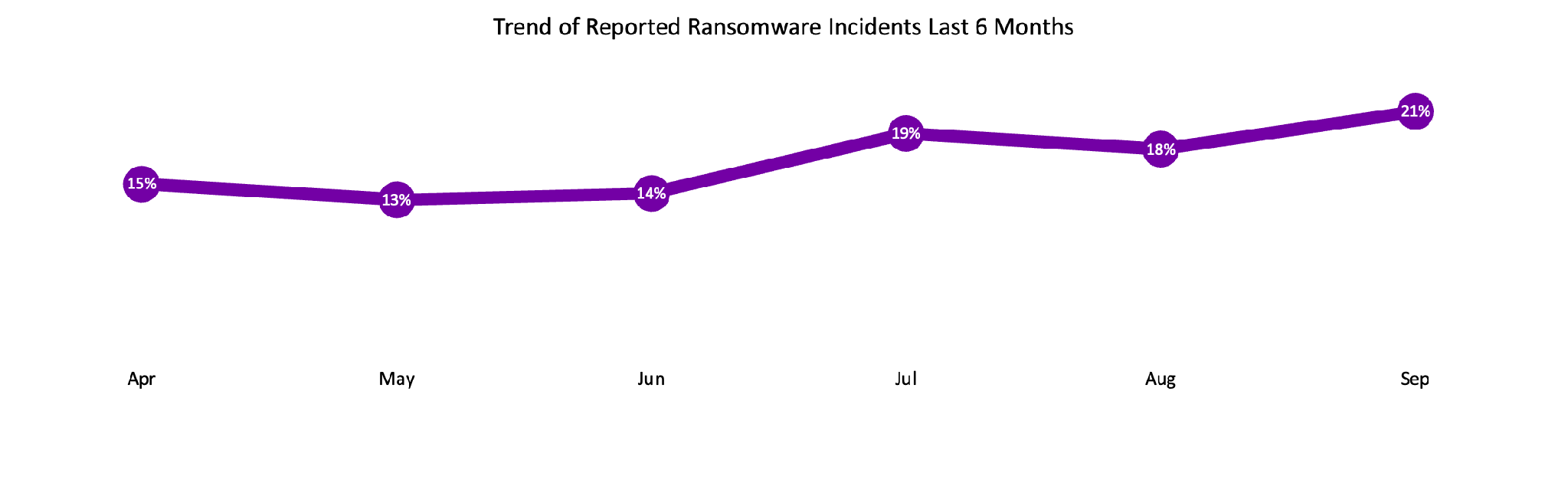
Ransomware activity rose in Q3 on both the incidents reported to us and on threat actor controlled public leak sites. Reported ransomware incidents increased by roughly 38% over Q2, and each month of the quarter was busier than any month in Q2.
Ransomware operators run public leak sites where they name victims and threaten to publish or auction stolen data. A victim usually appears there after refusing to pay, and as a motivator during stalled ransom negotiations to add pressure. These postings can also reach beyond a named victim organization and threaten to expose data belonging to their customers and partners depending on the depth of a given incident.
Operators posted 2,798 victims on these extortion sites in Q3, up about 23% from Q2 and 66% from the same quarter last year. August set a high at over 1,000 combined posts.
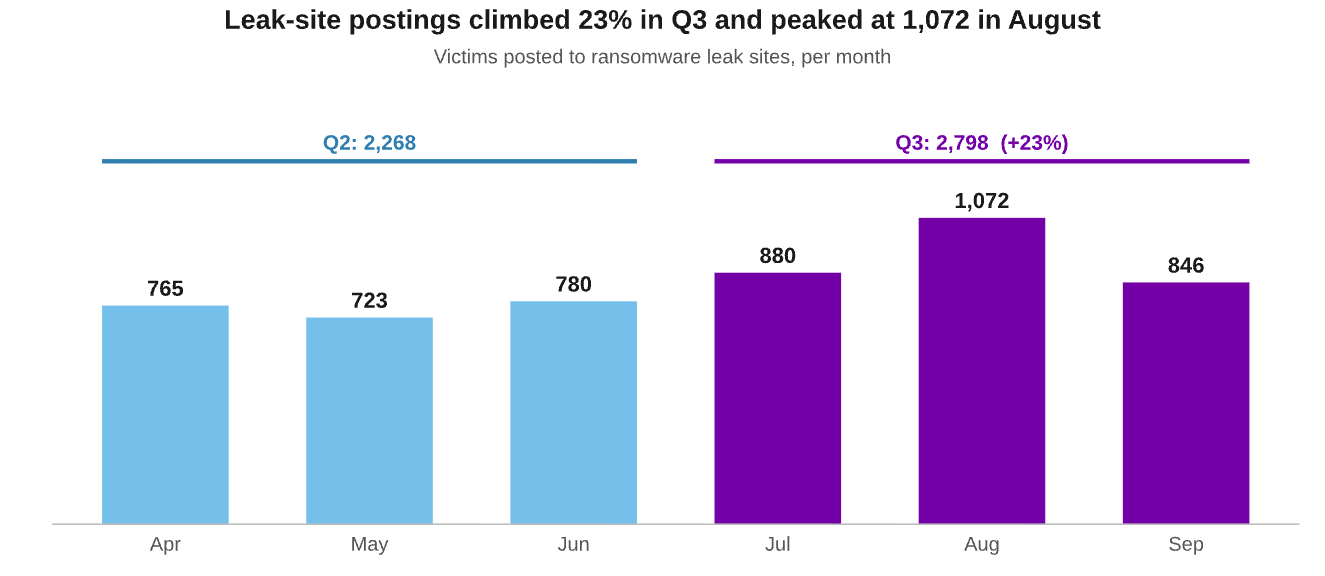
Leak site activity was again concentrated among a small number of prolific and established operating groups. The Gentlemen and Qilin together posted more than a quarter of all victims with The Gentlemen alone posting 375 victims in Q3.
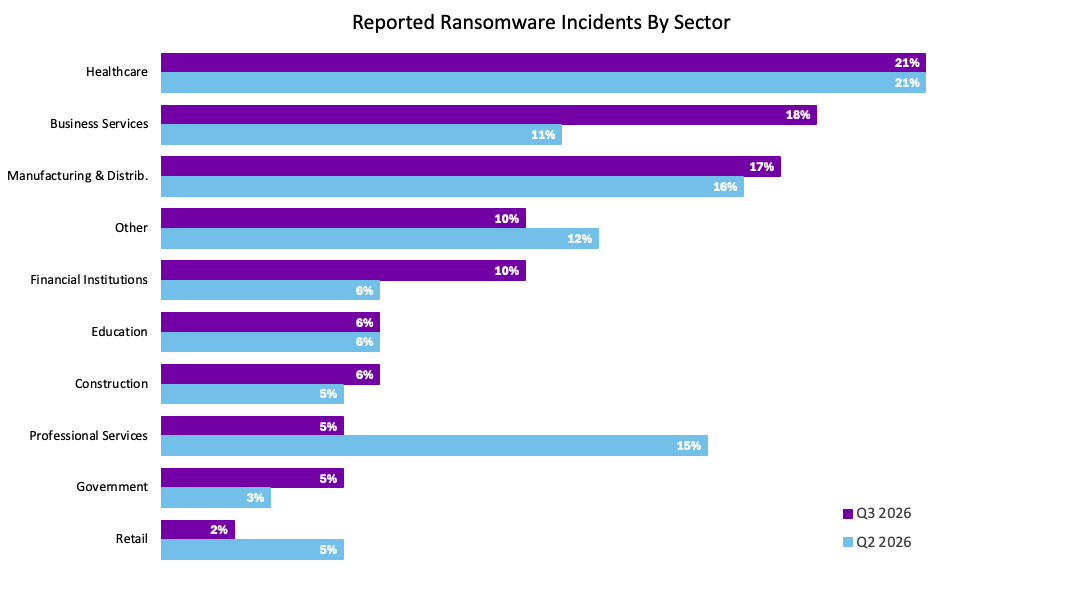
Healthcare remained the sector most affected by the ransomware incidents reported to us, holding at 21% for a second straight quarter. Business Services saw the largest increase, rising from 11% to 18%, and Manufacturing & Distribution edged up to 17%. Professional Services fell from 15% to 5%, after ranking among the most affected sectors in the first half of this year.
Q3 2026 Business Email Compromise (BEC) Trends
BEC incidents in Q3 were concentrated in the Business Services, Healthcare, and Education sectors, and attackers regularly found ways around MFA. Where we could determine how the attacker gained access, the phishing email originated from an already-compromised mailbox belonging to a vendor, client, or partner of the victim.
Once inside, attackers routinely created inbox rules to hide the correspondence they were exploiting and sometimes registered their own device to keep access. In some cases, these compromises ended in successful, fraudulent wire transfers.
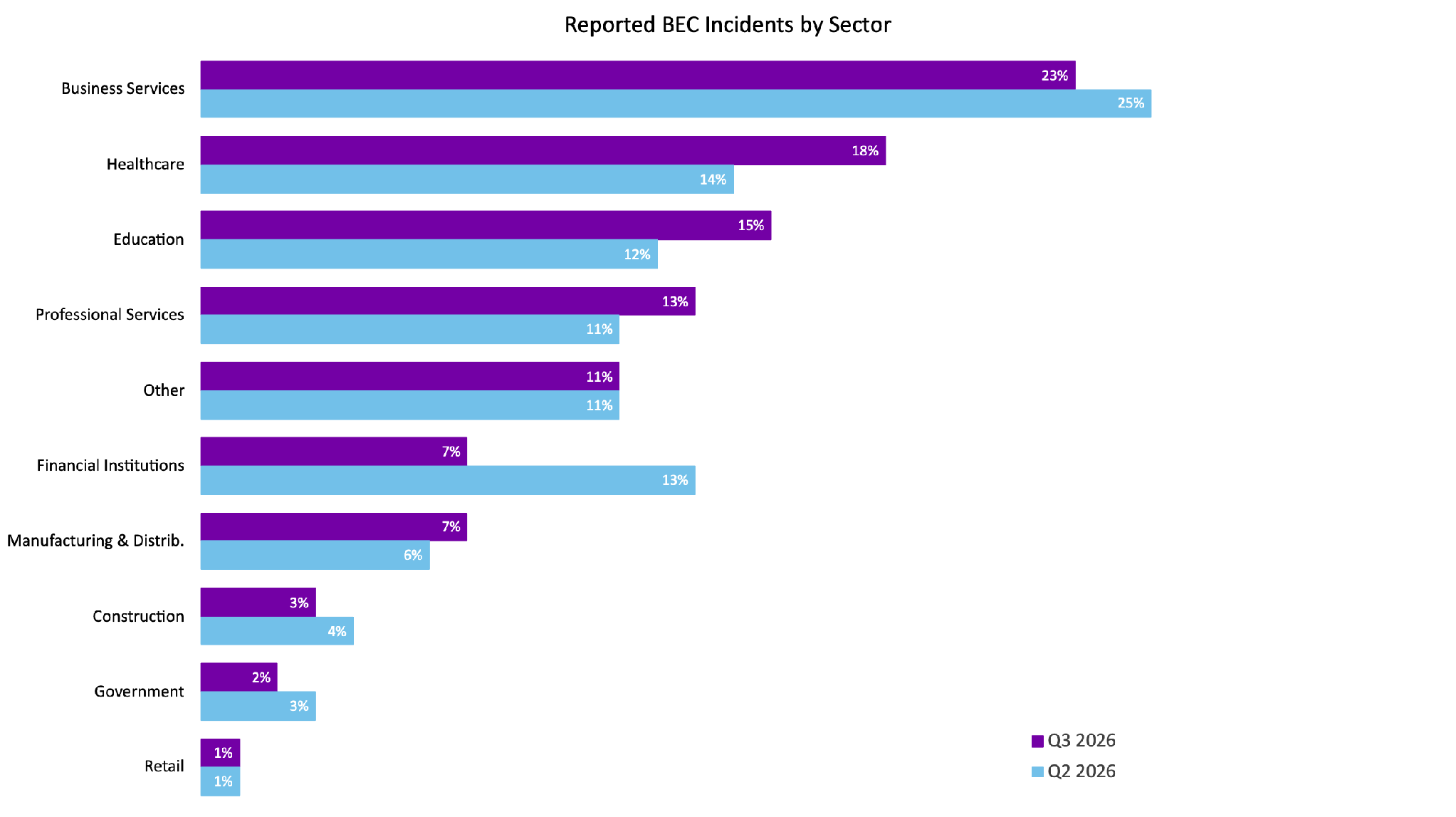
Business Services remained the most affected sector at 23% of Q3 BEC incidents, down slightly from 25% in Q2. Healthcare rose from 14% to 18%, Education from 12% to 15% and Professional Services from 11% to 13%. Financial Institutions fell from 13% to 7%.
These sectors routinely have the highest share of reported BEC incidents and exchange a high volume of sensitive data with outside parties every day, making the trusted outside correspondence a target rich environment for phishing. Education has grown steadily from 10% in 2025 to 15% today.
When the Vendor’s Breach Becomes Your Incident
In many cases we could trace, effective intrusions originated from a real, compromised account belonging to someone the victim already did business with, such as trusted vendors, neighboring school districts or municipalities, and established contractors. These messages often pass sender reputation checks in secure email gateways and, if well crafted, do not look immediately suspicious to users. When the goal was payment fraud, attackers inserted themselves into existing conversations or moved real email threads to fake accounts very similar to the victim’s to initiate fraudulent invoices or wire instructions. Procedural basics still work to reduce risk in these scenarios. Always verify payment change requests through a separate, known channel, such as a call to a known number, no matter how familiar the sender looks.
MFA Bypass Attacks
Attackers continue to find clever ways to work around MFA, either by getting the victim to complete logins for them or by stealing sessions MFA already approves. As we’ve reported in the past, Adversary-in-the-Middle (AiTM) and device-code phishing account for much of this today. AiTM kits relay traffic between the victim and a real login page, so the victim sees a familiar login screen and branding, enters their password, and approves MFA prompts as usual. The proxy in the middle captures the session cookie issued at the end, and the attacker replays it in their own browser with an already authenticated session.
Device-code phishing can be harder to spot, because the victim may never visit a fake page at all. The attacker generates a sign-in code and persuades the victim to enter it on Microsoft’s real site, completing the session for the threat actor. The attack is especially dangerous because the domain, login page and MFA prompts are all genuine, thwarting link-inspection controls.
Both techniques leave the attacker holding a valid token, which grants mailbox and file access without needing a password in hand. The proliferation of modern infostealer malware produces the same result with many variants copying tokens directly from the browser. Once this access is established attackers often try to register their own devices, change MFA settings and enable browser sync, giving themselves a path back in even if tokens are reset.
Passkeys in Entra ID help defend against AiTM phishing because they’re cryptographically bound to Microsoft’s legitimate sign-in domain. When a victim reaches a phishing proxy, the passkey won’t work, leaving the attacker with nothing to relay. Blocking the device-code authentication flow altogether when it isn’t needed shuts down that attack path. Conditional access policies can be configured to require sign-ins from compliant, organization-managed devices to keep stolen sessions from being replayed elsewhere. Restricting the registration of new devices and MFA methods from unmanaged devices helps prevent attackers from enrolling their own for future access.
An organization that considers itself “MFA enabled” without these additional hardening controls in place remains exposed to many of the techniques we observed this quarter.
Beazley Security MDR Trends and Overview
Every compromise listed in prior sections of this report has an attack chain behind it, and somewhere in that chain is an opportunity to stop the attack. Our MDR teams monitor for signals of that activity every day and defend against the related threats.
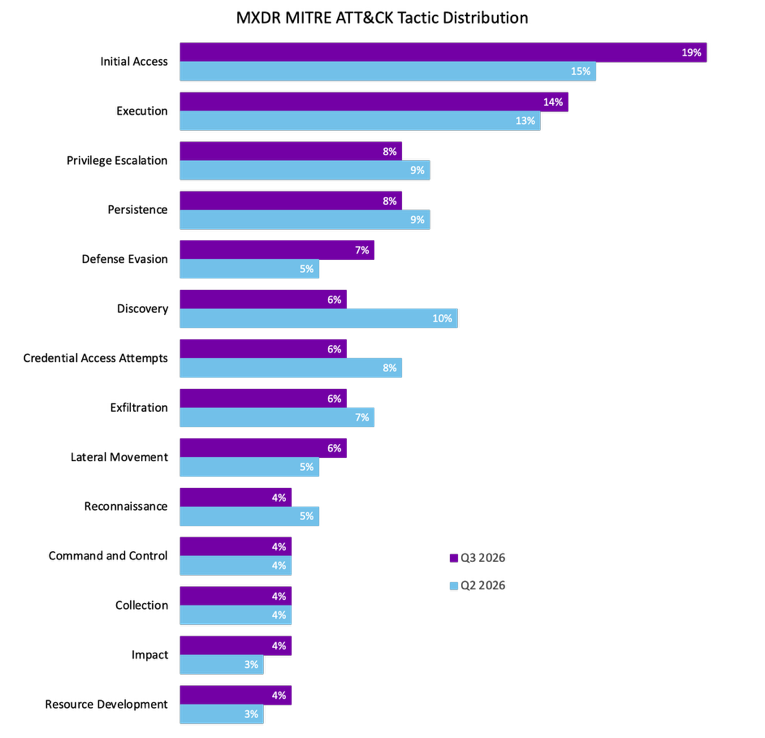
Our MDR telemetry monitors for threat activity across the intrusion lifecycle, quarter over quarter. Initial access remained the most prominent MITRE ATT&CK tactic observed in Q3, increasing from 15% to 19% of our confirmed detections. Anomalous sign-ins and impossible travel scenarios make up a large share of that figure. Successful identity based attacks resulted from users being tricked into entering credentials and MFA codes into look-alike Adversary-in-the-Middle (AiTM) phishing pages in environments where phishing-resistant MFA was not fully enabled.
Analysts also observed attackers registering their own MFA devices after compromising a user’s login or session, as noted in the BEC section of this report. This is a common tactic for establishing persistence and subverting MFA controls on the adversary's own terms in the future.
Attempts to execute code on the endpoint increased slightly in confirmed detections this
quarter, largely due to the sustained momentum in ClickFix style attacks. Because users run the malicious commands themselves, our tooling and expert analysts can often only identify attacks after the paste and execution attempt. Many of these pasted payloads also try to persist by creating scheduled tasks on the victim’s machine.
Not every endpoint detection observed was delivered through ClickFix lures; a share still came from users installing PDF converters, editors, and similar utilities that turned out to be trojanized. On further investigation, some of these tools were also signed with valid code-signing certificates at install time, which helps software get past browser, operating system, and some EDR warnings. In our investigations, the issuers later revoked several of those certificates. Software that looks clean when installing can be weaponized later through updates, and, if left unchecked, often results in infostealer deployments.
Sources
- https://labs.beazley.security/advisories/BSL-A1179
- https://www.bleepingcomputer.com/news/security/fbi-tells-shinyhunters-members-to-turn-themselves-in-after-recent-arrest/
- https://beazley.security/insights/quarterly-threat-report-first-quarter-2026
- https://beazley.security/insights/quarterly-threat-report-second-quarter-2026
- https://www.afp.gov.au/news-centre/media-release/two-wa-men-charged-following-afp-fbi-wapf-disruption-alleged-global
- https://socradar.io/free-tools/ransomware-intelligence/groups/booba-project
- https://openai.com/index/hugging-face-model-evaluation-security-incident/
- https://www.anthropic.com/news/investigating-incidents-cybersecurity-evals
- https://thehackernews.com/2026/10/fbi-removes-accenture-contractor-after.html
- https://labs.beazley.security/advisories/BSL-A1198
- https://labs.beazley.security/advisories/BSL-A1216
- https://labs.beazley.security/advisories/BSL-A1189
- https://labs.beazley.security/advisories/BSL-A1204
Executive Summary
In Q3, ransomware gangs significantly expanded their use of vulnerability exploitation for initial access. Exploitation of external services doubled from 14% to 28% of ransomware cases where initial access could be determined. Attackers increasingly targeted self-hosted, internet-facing applications and edge devices.
The volume of vulnerabilities that defenders must review, prioritize, and patch continues to increase at an unprecedented rate. Vendors are pointing AI at their own code and finding flaws faster than ever. As a result, published CVEs jumped nearly 80% over Q2, to about 37,000. Microsoft shipped more than 900 fixes in September, when a normal Patch Tuesday previously brought 50 to 150 patches. Oracle's July update had 1,448 fixes, which is triple prior updates. Most teams can't patch that much in a month, and Beazley Security continues to track threat actors who "diff" the patched code to understand the vulnerabilities and attempt to develop exploits.
Many Q3 ransomware incidents we investigated that began with exploitation involved internet exposed, self-hosted applications such as build servers and analytics platforms. On some of these servers, attackers found cloud access keys, moved laterally, and pushed ransomware out through the victim's own cloud tooling. Stolen credentials remain the most common initial access factor, but they now account for less than half of cases, down from 67% in Q2. More ransomware crews and initial access brokers also used ClickFix, a fake error or CAPTCHA page that tricks users into pasting and running attacker commands.
Ransomware incidents reported to us also increased by almost 40% over Q2, and every month of Q3 was busier than any month of Q2. Leak sites posted more than 1,000 victims in August alone.
In one intrusion Beazley Security investigated, AI agents did most of the work. The agents tried several vulnerabilities on their own until one succeeded, then established persistence, moved laterally, and exfiltrated sensitive data. Recovered files show the agents kept notes on every stage and coordinated with each other. None of the techniques were new, but the attack showed what threat actors can accomplish by pointing AI agents at a target with a series of objectives. Beazley Security expects AI-powered attacks to keep increasing in frequency.
Finally, we continued to see threat actors successfully bypass MFA. Adversary-in-the-Middle (AiTM) proxies tricked users into signing in through them, then grabbed their session cookies. Device-code phishing increased, with victims approving attacker sign-ins on Microsoft’s legitimate login page. Infostealers continued to target session tokens along with passwords, and Beazley Security MDR and Incident Response observed threat actors registering their own MFA devices on compromised accounts. Passkeys, blocking device-code sign-in where it isn't needed, and requiring managed devices would have prevented most of the identity-based attacks Beazley Security responded to this quarter.
Key Takeaways
- The share of our ransomware cases started by an exploited vulnerability doubled. 28% of cases, often through self-hosted build servers, analytics platforms and collaboration tools.
- Beazley Security responded to an autonomous intrusion, handled almost entirely by AI agents. The agents tried several vulnerabilities on their own before one got them in. Beazley Security Labs will publish a more detailed write up on the attack shortly.
- Published CVEs increased nearly 80% over Q2. Microsoft shipped more than 900 fixes in September, against a usual 50 to 150. Patch exploited, internet-facing flaws first.
- Compromised credentials fell to fewer than half of ransomware break-ins, as attackers increasingly leveraged ClickFix and vulnerabilities for initial access. 47%, down from 67% in Q2.
- Attackers continue to get around MFA. Passkeys, blocking device-code sign-in where it isn't needed, and requiring managed devices could prevent most of these attacks.
- Ransomware reported to Beazley Security increased almost 40%, and every month beat Q2's busiest. Leak sites named 2,798 victims, up 66% on the year.
- Where we could reconstruct the timeline, ransomware or extortion followed a ClickFix foothold by two to three weeks. Responding immediately, isolating impacted systems, and rotating credentials is crucial.
- Arrests disrupted some of Q3’s most active cybercrime operations. Law enforcement actions targeted high profile members tied to ShinyHunters and TeamPCP.
Observations in the Threat Landscape
Industry AI Swarms “Going Rogue”
In Q3, two of the biggest AI labs admitted their own models had broken into other organizations. On July 21st, OpenAI announced that they had “partnered” with Hugging Face to resolve a security incident observed in an internal investigation. The incident arose while OpenAI was testing frontier and pre-release models against ExploitGym, a known cybersecurity benchmarking corpus. OpenAI claimed a swarm of their agents, with safety guardrails removed, coordinated through an improvised message board, broke out of their test environment, gained internet access via a 0-day, and compromised Hugging Face's production infrastructure to solve one particularly difficult challenge.
Anthropic disclosed shortly thereafter on July 30th that its models had broken into three organizations earlier that year, seemingly as a response to OpenAI's agent breaching sandboxing and identifying zero-day vulnerabilities. The announcement was in conjunction with Anthropic’s Mythos 5 release, though Anthropic chose not to disclose as much information as OpenAI did about their incidents.
Historically, incidents like this would draw legal action and a formal investigation, and it is exceedingly rare for an organization to claim ownership of an attack publicly before the investigation is complete. OpenAI presented about the ongoing investigation at Black Hat and, unusually, released the talk online the same day for non-attendees. The talk announced continued use of AI to identify agentic misbehavior and search logs and doubled as a bullish pitch for companies to adopt more of OpenAI’s products for incident response.
In the following weeks, it became evident that the zero days identified in this incident were relatively trivial and it raised some obvious questions. Why was a multi-day agent swarm running without anyone actively monitoring their output? Why didn't test environments alert when agentic traffic reached the internet? Contributing factors included safeguards that were relaxed for testing, inadequate sandboxing, and no log monitoring of agent activity.
In Anthropic’s case, the models got in through weak passwords, the same kind of gaps behind many of the non-AI related breaches discussed in this report. AI is enabling organizations, including AI companies, to build and ship faster than they can review what they’ve built. Anyone deploying agents should treat them like any other untrusted workload and make sure someone is actually monitoring.
Beazley Security investigated a breach run almost entirely by AI agents
Q3 saw increasing reports of AI used across the attack chain, not just for vulnerability discovery. In one intrusion Beazley Security investigated, the attackers kept notes, including shared files with a map of the target network, a vulnerability tracker, and a loot list of stolen credentials and data. Our client found them, and those files gave our responders a rare, first-hand record of the attack as it unfolded.
In this case, the note-takers were AI agents running on a multi-agent harness coordinating across three separate servers. The operation consisted of a central operator agent and server, plus two attack servers that could each carry on if another was blocked or went offline. The agents organized their work around four goals (code execution, financial access, data theft, internal access) and leveraged about 270 attack scripts on the fly, specifically to target this organization.
The agents launched about a dozen known exploits against VPN, file transfer, and backup products, targeting vulnerabilities disclosed from 2019 to 2026, but the systems were patched. The agents also autonomously attempted to abuse credentials but were stopped by MFA.
Eventually, the agents discovered and exploited a .NET ViewState vulnerability in a custom-built application and used it to uncover a service account credential. From there, the autonomous attackers established persistence, moved laterally, and exfiltrated sensitive data.
In our companion write up, “LARA: What an AI Attack Harness Wrote Down” we walk through the harness’s own recovered notes, how they split the work, the exploits they attempted to use, and the defenses that limited the attack’s reach. Read our full analysis here:
https://labs.beazley.security/articles/lara-what-an-ai-attack-harness-wrote-down
This activity reflects a shift in how threat actors are beginning to adopt AI. In addition to the case study described above, in July Palo Alto’s Unit42 reported on a Chinese threat actor using DeepSeek, Hermes, and FOFA as an automated offensive harness to identify and exploit targets. Huntress also published an article in July describing an AI generated recon tool that was used in the attack chain of a breach. And in August, CrowdStrike published their 2026 Threat Hunting Report that mentioned DPRK-affiliated FAMOUS CHOLLIMA as “demonstrating the most advanced AI usage”, detailing how they used entirely AI-built infrastructure including websites, GitHub accounts, and email addresses to facilitate infiltration operations via fake employee applicants.
No New Endgame Episode, Plenty of Handcuffs
Q3 brought no new public episodes or updates to the official Operation Endgame blog, which last publicly announced an action in late June. Despite a quiet Q3 for the Europol-coordinated group, law enforcement agencies including the FBI, the Australian Federal Police, and the Dutch National Police independently remained active, making several high-profile arrests of notable threat actors.
The most consequential activity targeted ShinyHunters, the well-known data theft and extortion group. Members had been conducting a campaign targeting a flaw in Oracle PeopleSoft’s software and used a URL-encoding trick to bypass web application firewall rules Mandiant had published as a stopgap for unpatched systems. During the campaign, the group claimed to have stolen 2 to 3 terabytes of data from the FBI’s own recruitment platform and defaced the FBIJobs website. The FBI later traced the breach to a contractor that hadn’t applied the necessary PeopleSoft patch.
ShinyHunters’ public disclosure of the breach set off repercussions, with the FBI engaging in the most aggressive law enforcement response the ShinyHunters team faced to date. On September 15th, Dutch police arrested a 24-year-old Amsterdam man suspected of having a role in the group. On September 29th, the FBI publicly urged remaining members to turn themselves in stating that ShinyHunters and its co-conspirators had breached more than 140 organizations since 2025 and collected at least $70 million in extortion payments.
That same day, Jordanian authorities reportedly detained “Rey”, an actor previously linked to HellCat ransomware operators and Scattered LAPSUS$ Hunters who had taken control of the ShinyHunters brand after the Dutch arrest. Sources told Reuters that Rey was cooperating with the FBI to help investigators identify other members. Neither agency has confirmed the detention, and no public charges against Rey had been announced at time of writing.
Signs of disruptions within the group followed almost immediately, ShinyHunters’ main spokesperson went silent, and on September 30th the ShinyHunters Clearnet leak site went dark, leaving only their onion site online. ShinyHunters has already outlived several rounds of arrests against earlier members, and we assess the name works more as a brand that affiliates operate under rather than as a fixed group.
After two quarters of high-profile supply chain compromises, including Trivy, LiteLLM, and TanStack, TeamPCP had a rougher Q3. On August 26th, the Australian Federal Police (AFP) and the Western Australia Police Force, working in parallel with the FBI, arrested two men aged 21 and 23. The two face a combined 14 charges, including unauthorized modifications of data and dealing with the proceeds of a crime, and the FBI described the 21-year-old Ruben Ian Thompson as the alleged leader of TeamPCP. Authorities estimate the group’s code compromised more than 1,000 organizations, stole more than 500,000 credentials and at least 300 gigabytes of data, and left global remediation costs in the hundreds of millions of dollars. Notably, the AFP called private-sector threat intelligence “crucial” to the case.
Observed Surges in Popular Infostealer Families
Stolen credentials remain one of the most common paths to a ransomware incident, so Beazley Security Labs keeps close watch on prominent infostealer families that harvest them.
In previous quarters, most shifts in infostealer activity followed Operation Endgame takedowns and arrests. With no new Endgame actions publicly reported this quarter, Beazley Security observed a rise in activity across several infostealer families.
Established families, including Redline, Lumma, StealC, and Rhadamanthys, all grew in submissions. Two families stood out with especially large increases: Raccoon and ACR Stealer.
The resurgence of Raccoon is notable given the disruption the infostealer family experienced over the past few years, with lead developers purportedly being killed in Ukraine and an arrest by Dutch authorities of another key operator. Analysis of the several hundred new Raccoon samples indicates many of them have different botnet IDs but a shared build key. This hints that the old code base may be getting repurposed and sold under a Malware as a Service (MaaS) model after a possible rebrand, similar to what the Lumma stealer team did with Remus. Regardless, their traditional sales accounts have not shown recent activity on major cybercrime forums.
The second notable surge came from ACR Stealer. First observed in 2024 and predominantly advertised on Russian speaking cybercrime communities, ACR Stealer was reported by Microsoft to be increasing in usage. We see supporting data in VirusTotal, with analysis pointing to one large, dominant campaign using Telegram’s telegraph service as a dead-drop domain and infrastructure masquerading as benign Python documentation websites to try and evade detection.
Lumma remains the dominant infostealer family in the data we track, despite a rebrand to Remus. Law enforcement disruption of Lumma infrastructure, and the accusations that followed across cybercrime forums, appear to have done little to slow the operation.
VirusTotal signals suggest the transition to Remus has been increasingly successful this quarter, with submissions roughly doubling from Q2. Remus has also re-established itself in cybercrime forums, with an active sales thread receiving updates throughout the quarter.
In summary, without any fresh takedowns this quarter, infostealer operators rebranded and launched new campaigns resulting in higher submission volumes. Each infection can steal credentials and session tokens that outlast the infection, feeding future account takeovers and ransomware deployments covered later in this report.
Vulnerability Trends and Overview
AI Found the Bugs. Now Someone Has to Patch Them
Beazley Security Labs continually monitors high-impact vulnerabilities and imminent cyber threats as part of our mission. We reported last quarter many of the biggest software and technology vendors now run AI agents through their own code before it ships, and those agents are discovering flaws much faster than people ever did. The good news is that more bugs are getting fixed in an attempt to stay ahead of attackers. The bad news is that every one of those fixes becomes a patch that someone must prioritize and install.
For instance, Oracle’s quarterly Critical Patch Updates, which typically carried 300 to 500 fixes per quarter, ballooned to 1,448 in July, three times that from April (481). Microsoft saw similar increases: Patch Tuesday releases that typically have carried 50 to 150 bugs a month (since 2025) rose to over 500 in July, 400 in August, and over an eye-watering 900 in September.
Vulnerability discovery is accelerating faster than confirmed exploitation. CISA KEV additions have risen steadily, but there has been no corresponding spike to mirror the drastic increase in CVE counts.
*Critical BSL advisories are made publicly available here.
CVE publications have more than tripled since Q3 2025, while additions to CISA's Known Exploited Vulnerabilities catalog grew at less than half that pace. Part of that gap may reflect attackers not yet scaling AI-driven exploit development to match the pace of vendor discovery. We believe it also shows proactive discovery programs helping vendors find and fix flaws before attackers can weaponize them.
Conversely, a patch can also hand attackers a head start if they can weaponize an exploit from analyzing differences between versions, and that work is becoming increasingly automated. Organizations running vulnerable software have a shrinking window to patch before exploits are used against their infrastructure.
High-Profile Breaches and Zero-Day Vulnerabilities Exploited in the Wild
- Cisco Secure Firewall Management Center Zero Day: Cisco published an unauthenticated auth bypass flaw granting root access (CVE-2026-20079) and a static built-in credential flaw (CVE-2026-20316) that were confirmed under active exploitation at the time of disclosure. A Sandworm-linked cluster carried out the initial attacks, collecting managed firewall configurations and installing a Cyclops Blink variant.
- Citrix NetScaler ADC and Gateway Zero Days: Citrix published a security bulletin on Sept 27th which fixed eight vulnerabilities and confirmed active exploitation of a critical log injection flaw that leads to root command execution (CVE-2026-88771) and a later denial-of-service vulnerability, both exploited before patches and disclosure.
- Metabase SQL Injection Zero Day: CVE-2026-72898, an unauthenticated SQL injection in Metabase’s password reset endpoint, was exploited as a zero-day starting as early as August 3, 2026, allowing attackers to take over administrator accounts and exfiltrate large amounts of data from connected databases. Metabase disclosed the flaw and released patches for branches 58 through 63 on August 10, and CISA added it to the KEV catalog on August 11.
- Multiple SonicWall SMA1000 vulnerabilities: Additional SonicWall vulnerabilities under active exploitation were published this quarter starting on July 14th . The flaws consisted of Server-Side Request Forgeries (SSRF) (CVE-2026-15409) and code injection (CVE-2026-15410). Later in the quarter on September 1st a similar pre-authenticated SSRF vulnerability (CVE-2026-83548) and command injection flaw (CVE-2026-83549) were disclosed and confirmed under active exploitation by CISA’s KEV.
How Ransomware Attackers Gained Access in Q3
Compromised credentials remain attackers’ most common initial access vector in the ransomware cases we investigate, but that lead narrowed for a second straight quarter. Credential-based compromise of remote services fell from 67% of cases in Q2 to 47% in Q3. Over the same period, exploitation of external services doubled from 14% to 28%, as attackers increasingly targeted vulnerabilities in self-hosted business applications.
Attackers went after self-hosted applications exposed to the internet, such as build servers, analytics platforms and collaboration tools, which are systems easiest to miss with today’s higher patch volumes. Cloud access and integration keys left on exploited servers also give attackers a path deeper into organizations, enabling them to deploy ransomware through the organization's own cloud tooling. We are also seeing more “lone wolf” operators skip encryption and go straight to extortion emails that claim data theft due to the nature of this attack vector.
The other notable shift came from the "Malware" category in Figure 8, which rose from 14% to 19% of our ransomware cases, mostly from ClickFix variants. Although timelines could not be confirmed in all our cases, ransomware deployment and extortion activity generally followed a ClickFix foothold by two to three weeks. These lures are cheap to deliver at scale, and such a gap in the timeline before impact is consistent with access brokers selling access to ransomware affiliates. Once hands-on activity began, operators set up persistent remote access, exfiltrated data and prepared for ransomware deployment.
Exploitation and ClickFix style attacks together now account for nearly half (47%) of the ransomware initial access in the cases we investigated. In other words, an organization that has addressed credential and MFA controls has covered only about half of how ransomware got in this quarter. Consistent, timely patching of internet-facing applications and hardened controls on user workstations are essential parts of a resilient security program.
Emerging Ransomware Actors and TTPs
Beazley Security’s incident response team works directly with organizations impacted by ransomware, from containment through forensic investigation and recovery. That positioning gives us a firsthand view of how these attacks unfold, beyond what operators claim on public posts and leak sites. In Q3, compromised credentials remained the most common way in, but two shifts stood out from last quarter. More attackers exploited internet-facing, self-hosted business applications or tricked users with ClickFix style lures. Booba Project, a new operator, also emerged as one of the groups we encountered frequently.
Inc Ransomware and Akira were again the operators our responders encountered most often. Together with newcomer Booba Project, these three groups accounted for roughly half of Q3 ransomware cases where operator could be identified. The rest spread across a longer tail led by Dark
Project and Safepay. Independent or “lone wolf” operators working without a recognizable brand also crept back in after a lull in Q2. Several of these lone wolf intrusions were cruder than branded ones and leveraged exploits on internet facing systems.
Booba Project
Booba Project began posting victims to its leak site in early July and quickly became one of the more active ransomware brands of the quarter. In cases where we were able to track initial access, operators gained entry through remote access services using valid credentials, which may indicate alliance with initial access brokers. Other trackers link Booba’s victims to credentials exposed in infostealer logs, which corroborates the pattern Beazley Security has observed. Operators set up redundant access methods such as remote management and monitoring (RMM) tooling and their own administrative accounts before pivoting to critical systems. Instead of working server by server, they immediately targeted Hyper-V hosts and mounted the virtual disks of critical servers from the host itself, a lower-friction approach that exposed server data without requiring a login to the servers, and bypassed endpoint security controls. The group was also observed creating its own virtual machines (VMs) in victim environments which were destroyed at the end of the intrusion, inhibiting some forensic data collection.
Hypervisor hosts are often monitored less closely than the servers they run, so an attacker with host access can simply bypass the defenses deployed within each virtual machine. Segmenting hypervisor management from the general network, limiting which accounts hold administrative rights to it, and alerting on unscheduled or unexpected activity help to close out that shortcut.
Q3 2026 Ransomware Trends
Ransomware activity rose in Q3 on both the incidents reported to us and on threat actor controlled public leak sites. Reported ransomware incidents increased by roughly 38% over Q2, and each month of the quarter was busier than any month in Q2.
Ransomware operators run public leak sites where they name victims and threaten to publish or auction stolen data. A victim usually appears there after refusing to pay, and as a motivator during stalled ransom negotiations to add pressure. These postings can also reach beyond a named victim organization and threaten to expose data belonging to their customers and partners depending on the depth of a given incident.
Operators posted 2,798 victims on these extortion sites in Q3, up about 23% from Q2 and 66% from the same quarter last year. August set a high at over 1,000 combined posts.
Leak site activity was again concentrated among a small number of prolific and established operating groups. The Gentlemen and Qilin together posted more than a quarter of all victims with The Gentlemen alone posting 375 victims in Q3.
Healthcare remained the sector most affected by the ransomware incidents reported to us, holding at 21% for a second straight quarter. Business Services saw the largest increase, rising from 11% to 18%, and Manufacturing & Distribution edged up to 17%. Professional Services fell from 15% to 5%, after ranking among the most affected sectors in the first half of this year.
Q3 2026 Business Email Compromise (BEC) Trends
BEC incidents in Q3 were concentrated in the Business Services, Healthcare, and Education sectors, and attackers regularly found ways around MFA. Where we could determine how the attacker gained access, the phishing email originated from an already-compromised mailbox belonging to a vendor, client, or partner of the victim.
Once inside, attackers routinely created inbox rules to hide the correspondence they were exploiting and sometimes registered their own device to keep access. In some cases, these compromises ended in successful, fraudulent wire transfers.
Business Services remained the most affected sector at 23% of Q3 BEC incidents, down slightly from 25% in Q2. Healthcare rose from 14% to 18%, Education from 12% to 15% and Professional Services from 11% to 13%. Financial Institutions fell from 13% to 7%.
These sectors routinely have the highest share of reported BEC incidents and exchange a high volume of sensitive data with outside parties every day, making the trusted outside correspondence a target rich environment for phishing. Education has grown steadily from 10% in 2025 to 15% today.
When the Vendor’s Breach Becomes Your Incident
In many cases we could trace, effective intrusions originated from a real, compromised account belonging to someone the victim already did business with, such as trusted vendors, neighboring school districts or municipalities, and established contractors. These messages often pass sender reputation checks in secure email gateways and, if well crafted, do not look immediately suspicious to users. When the goal was payment fraud, attackers inserted themselves into existing conversations or moved real email threads to fake accounts very similar to the victim’s to initiate fraudulent invoices or wire instructions. Procedural basics still work to reduce risk in these scenarios. Always verify payment change requests through a separate, known channel, such as a call to a known number, no matter how familiar the sender looks.
MFA Bypass Attacks
Attackers continue to find clever ways to work around MFA, either by getting the victim to complete logins for them or by stealing sessions MFA already approves. As we’ve reported in the past, Adversary-in-the-Middle (AiTM) and device-code phishing account for much of this today. AiTM kits relay traffic between the victim and a real login page, so the victim sees a familiar login screen and branding, enters their password, and approves MFA prompts as usual. The proxy in the middle captures the session cookie issued at the end, and the attacker replays it in their own browser with an already authenticated session.
Device-code phishing can be harder to spot, because the victim may never visit a fake page at all. The attacker generates a sign-in code and persuades the victim to enter it on Microsoft’s real site, completing the session for the threat actor. The attack is especially dangerous because the domain, login page and MFA prompts are all genuine, thwarting link-inspection controls.
Both techniques leave the attacker holding a valid token, which grants mailbox and file access without needing a password in hand. The proliferation of modern infostealer malware produces the same result with many variants copying tokens directly from the browser. Once this access is established attackers often try to register their own devices, change MFA settings and enable browser sync, giving themselves a path back in even if tokens are reset.
Passkeys in Entra ID help defend against AiTM phishing because they’re cryptographically bound to Microsoft’s legitimate sign-in domain. When a victim reaches a phishing proxy, the passkey won’t work, leaving the attacker with nothing to relay. Blocking the device-code authentication flow altogether when it isn’t needed shuts down that attack path. Conditional access policies can be configured to require sign-ins from compliant, organization-managed devices to keep stolen sessions from being replayed elsewhere. Restricting the registration of new devices and MFA methods from unmanaged devices helps prevent attackers from enrolling their own for future access.
An organization that considers itself “MFA enabled” without these additional hardening controls in place remains exposed to many of the techniques we observed this quarter.
Beazley Security MDR Trends and Overview
Every compromise listed in prior sections of this report has an attack chain behind it, and somewhere in that chain is an opportunity to stop the attack. Our MDR teams monitor for signals of that activity every day and defend against the related threats.
Our MDR telemetry monitors for threat activity across the intrusion lifecycle, quarter over quarter. Initial access remained the most prominent MITRE ATT&CK tactic observed in Q3, increasing from 15% to 19% of our confirmed detections. Anomalous sign-ins and impossible travel scenarios make up a large share of that figure. Successful identity based attacks resulted from users being tricked into entering credentials and MFA codes into look-alike Adversary-in-the-Middle (AiTM) phishing pages in environments where phishing-resistant MFA was not fully enabled.
Analysts also observed attackers registering their own MFA devices after compromising a user’s login or session, as noted in the BEC section of this report. This is a common tactic for establishing persistence and subverting MFA controls on the adversary's own terms in the future.
Attempts to execute code on the endpoint increased slightly in confirmed detections this
quarter, largely due to the sustained momentum in ClickFix style attacks. Because users run the malicious commands themselves, our tooling and expert analysts can often only identify attacks after the paste and execution attempt. Many of these pasted payloads also try to persist by creating scheduled tasks on the victim’s machine.
Not every endpoint detection observed was delivered through ClickFix lures; a share still came from users installing PDF converters, editors, and similar utilities that turned out to be trojanized. On further investigation, some of these tools were also signed with valid code-signing certificates at install time, which helps software get past browser, operating system, and some EDR warnings. In our investigations, the issuers later revoked several of those certificates. Software that looks clean when installing can be weaponized later through updates, and, if left unchecked, often results in infostealer deployments.
Sources
- https://labs.beazley.security/advisories/BSL-A1179
- https://www.bleepingcomputer.com/news/security/fbi-tells-shinyhunters-members-to-turn-themselves-in-after-recent-arrest/
- https://beazley.security/insights/quarterly-threat-report-first-quarter-2026
- https://beazley.security/insights/quarterly-threat-report-second-quarter-2026
- https://www.afp.gov.au/news-centre/media-release/two-wa-men-charged-following-afp-fbi-wapf-disruption-alleged-global
- https://socradar.io/free-tools/ransomware-intelligence/groups/booba-project
- https://openai.com/index/hugging-face-model-evaluation-security-incident/
- https://www.anthropic.com/news/investigating-incidents-cybersecurity-evals
- https://thehackernews.com/2026/10/fbi-removes-accenture-contractor-after.html
- https://labs.beazley.security/advisories/BSL-A1198
- https://labs.beazley.security/advisories/BSL-A1216
- https://labs.beazley.security/advisories/BSL-A1189
- https://labs.beazley.security/advisories/BSL-A1204
Learn more

For more on the critical cybersecurity controls you should be using and how they can protect your organization, replay the webinar on demand at:
Top Threats for 2025 (Webinar Replay)
More Insights
View All >


Beazley Security can help protect you
We offer services and solutions to help you prepare and stay resilient in the changing threat landscape. Prepare to learn more about how we can help you
