


Dark Web Monitoring is a service that continuously scans dark web marketplaces, forums, and breach repositories for your organization’s exposed credentials, then alerts your team when leaked or stolen credentials appear so you can act before attackers exploit them. Beazley Security delivers Dark Web Monitoring as part of its Exposure Management platform, giving security teams early visibility into credential exposure across their external attack surface.
Dark Web Monitoring (DWM) scans the dark and deep web to continuously detect leaked or stolen credentials, helping teams proactively respond before attackers use them to gain access, move laterally, or commit fraud using your organization’s identity.
Throughout 2026, the use of compromised but valid credentials was one of the leading access vectors for attackers, appearing in roughly 74% of breaches investigated by Beazley Security. With Dark Web Monitoring, you can identify exposed credentials, prevent unauthorized access, and reduce risk.

Amplify your Exposure Management platform capabilities
Our Dark Web Monitoring is an add-on to Beazley Security’s Exposure Management platform, extending its capabilities by monitoring forums for leaked credentials to reduce exposure risk at scale.

Monitor dark web sources
Continuously crawl and analyze millions of events from dark web forums, infostealer activity logs, ransomware leak sites, and publicly reported breaches to discover exposed credentials tied to your monitored domains.
Monitor dark web sources
Continuously crawl and analyze millions of events from dark web forums, infostealer activity logs, ransomware leak sites, and publicly reported breaches to discover exposed credentials tied to your monitored domains.

Prioritize risk by severity
Evaluate each exposed credential by severity and likelihood of misuse, helping your team separate lower-risk findings from credentials that could give attackers real access.
Prioritize risk by severity
Evaluate each exposed credential by severity and likelihood of misuse, helping your team separate lower-risk findings from credentials that could give attackers real access.

Reduce exposure at scale
Generate alerts for every exposed credential, giving your team early visibility to disable accounts, reset passwords, enforce MFA, and notify the right people before a leaked credential turns into an incident.
Reduce exposure at scale
Generate alerts for every exposed credential, giving your team early visibility to disable accounts, reset passwords, enforce MFA, and notify the right people before a leaked credential turns into an incident.
No items found.
Continuously reduce the risk of exposed credentials
Most organizations have no reliable way to track which of their credentials are exposed, circulating, or for sale on the dark web. Beazley Security’s Dark Web Monitoring automatically surfaces compromised credentials from underground sources to prevent escalation.
Automate credential monitoring across the dark web
Track the domains you already monitor in Exposure Management to find leaked credentials tied to your organization. Dark Web Monitoring scans dark web forums, infostealer logs, ransomware leak sites, and reported breaches, then generates alerts so your team can triage and remediate exposed credentials faster.
Focus on the credential-related risks that matter most
The platform applies layered severity logic to each alert, factoring in the potential impact of the exposure and the likelihood that the credentials are real, valid, and usable by an attacker. Your team can then leverage that context to identify and prioritize the threats that pose the greatest risk.
Scan up to 180 days of dark web credential exposure
Monitor compromised credentials associated with your organization that appeared on dark web sources within the past 180 days. Findings automatically generate alerts in VERACIS™, giving teams immediate visibility to investigate affected accounts, reset credentials, and reduce ongoing risk.
Respond to critical alerts with context
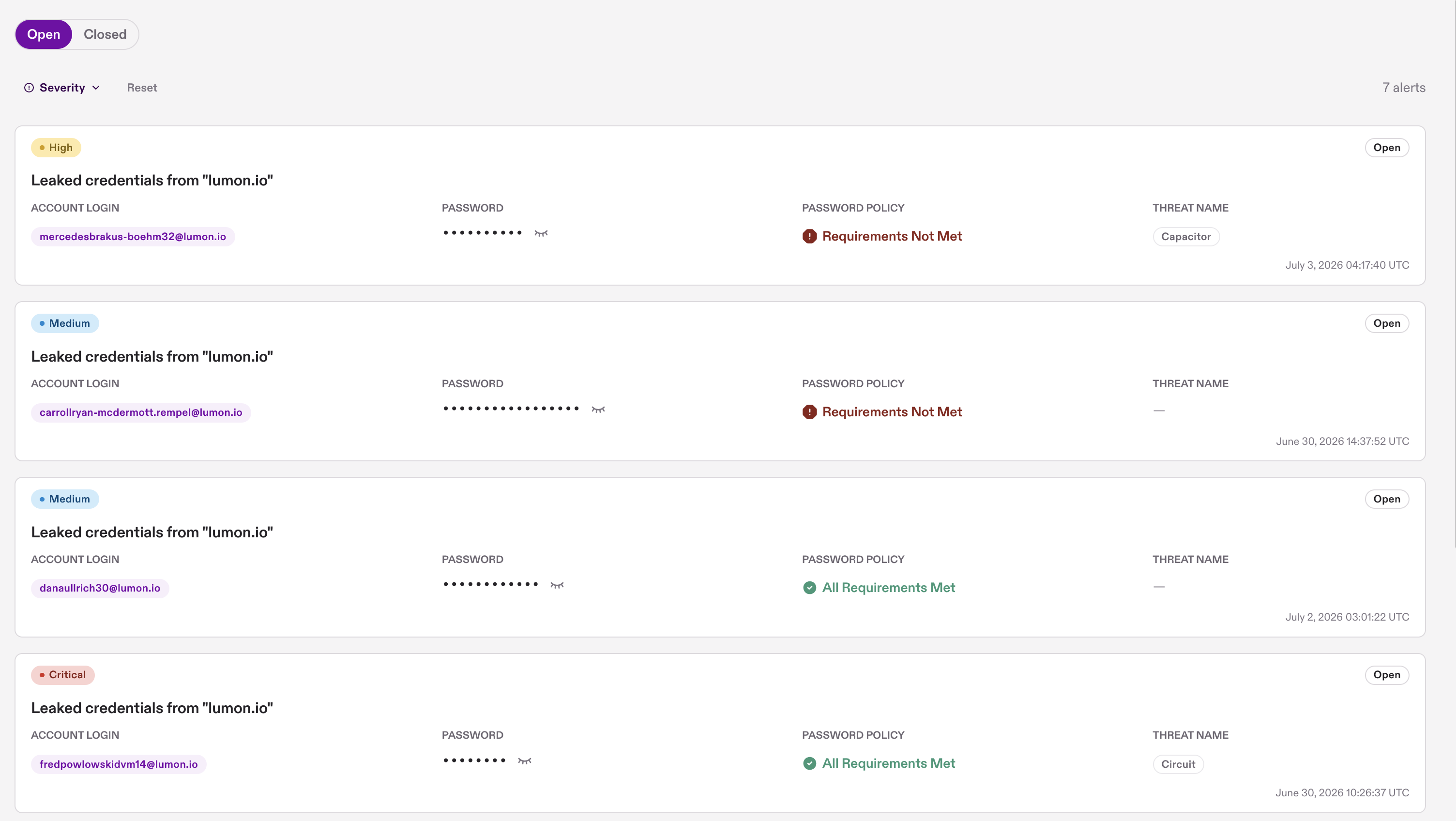
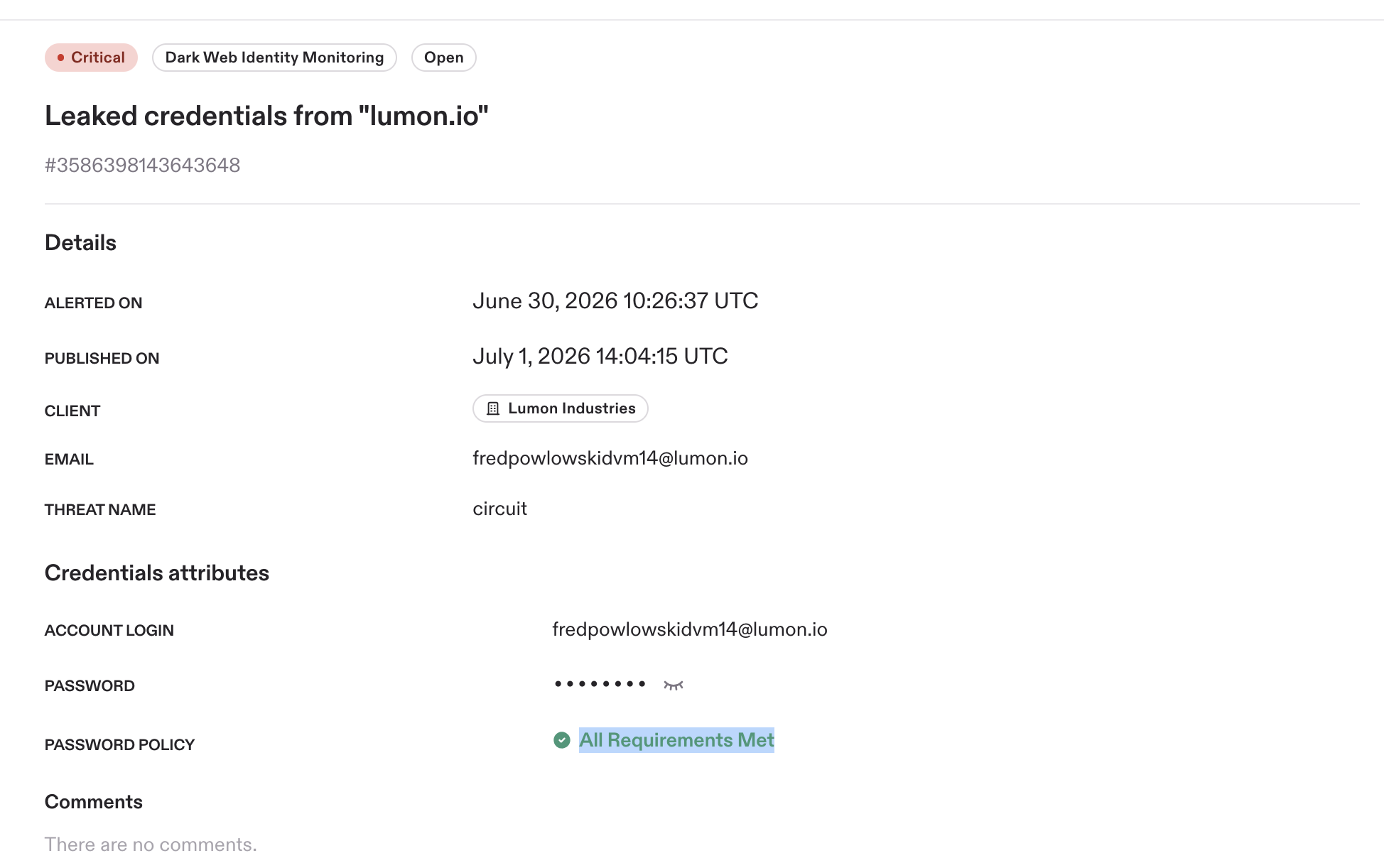
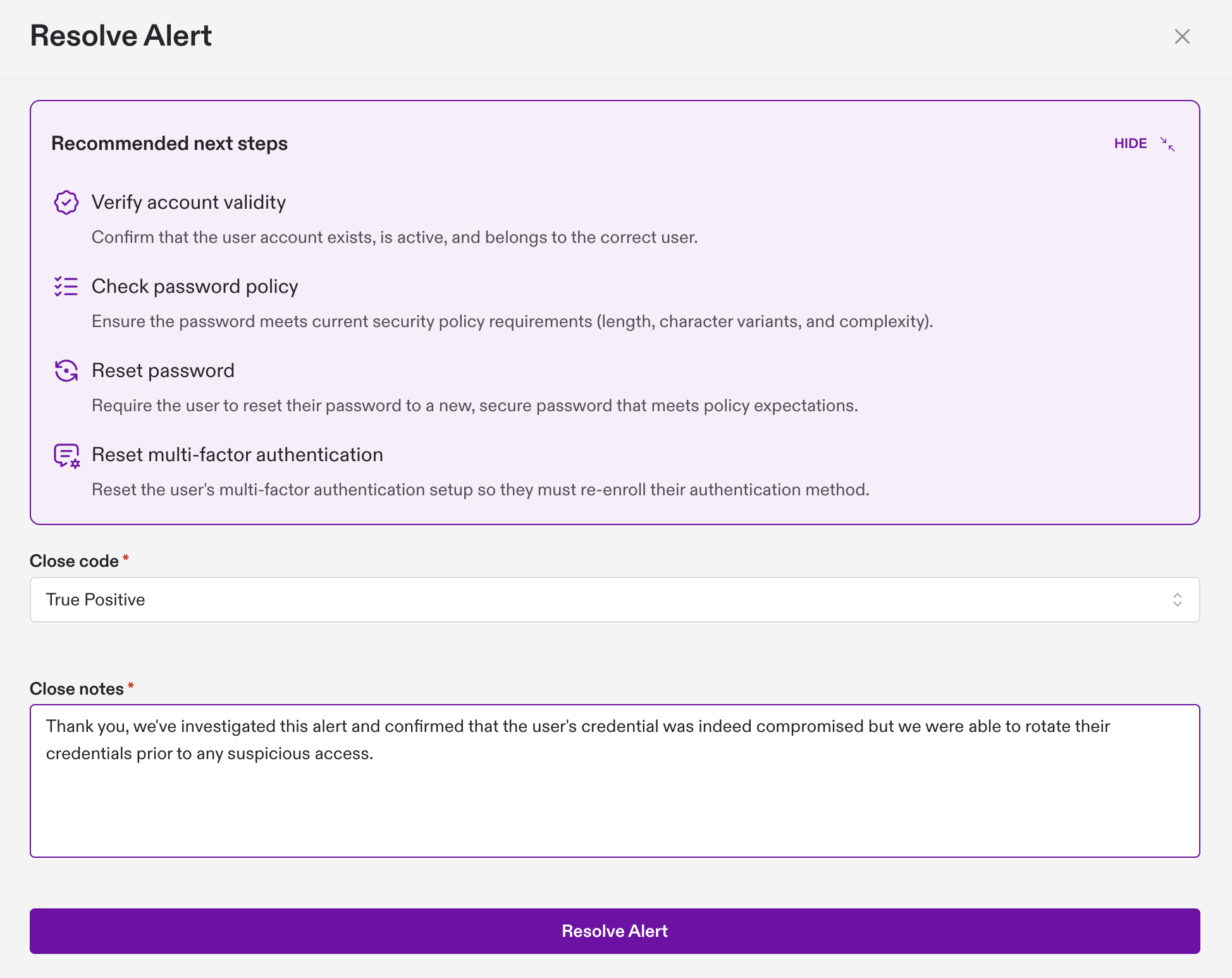
Centralize all compromised credential alerts in the VERACIS™ portal, where teams can triage, filter, investigate, and resolve findings by status, severity, and user. Alerts include clear remediation guidance and exposure context, including:
- The affected user email and exposed password, where available
- Whether the password meets your organization’s password policy
- The date and time the credentials were observed
- The service domain associated with the exposure
Augment protection with Managed Extended Detection and Response (MXDR)
When subscribed to Beazley Security’s MXDR service, Dark Web Monitoring alerts are integrated into a unified 24/7 response workflow. Our analysts triage exposed credentials on your behalf, confirm whether the accounts belong to active users, and check for signs of misuse. Where configured and approved response actions allow, our analysts may also temporarily disable the affected account until your organization’s IT team can reset the user’s credentials.

Activated with EM’s Professional and Enterprise plans
Dark Web Monitoring is included in the Professional and Enterprise tiers of Beazley Security’s Exposure Management platform. The module reduces credential-related risk by discovering exposed credentials early, ranking them by real-world impact, and giving teams the context they need to remediate quickly across the external attack surface.
Related services
.png)
Third-party Risk Monitoring
Extend monitoring to third-party suppliers with continuous external risk monitoring, vendor risk scoring, and actionable Security Posture Reports (SPRs).
Learn more
.png)
Offensive & Technical Security
Test your applications, infrastructure, and cloud environments to identify the vulnerabilities and security gaps that pose the highest risk.
Learn more
BEAZLEY SECURITY LABS INSIGHT
Credentials are the #1 entry point for attackers
Throughout 2026, Beazley Security incident responders found that compromised, valid credentials were the leading initial access method used by attackers, involved in roughly 74% of breaches. Dark Web Monitoring is built to surface exposed credentials early, so you can act before stolen data is weaponized:
- Credentials are monetized on dark web marketplaces and underground forums, sold individually or in large credential dumps spanning multiple breaches.
- Once obtained, attackers use them to gain higher-level access, maintain persistence, collect data, and move laterally toward sensitive resources.
- Early detection lets teams reset credentials and disable accounts before exposed data is exploited.
- Acting quickly narrows the window for credential stuffing, lateral movement, and fraud.
What is Dark Web Monitoring?

Do I need to activate Beazley Security’s Exposure Management platform to use DWM?
Yes. DWM is delivered as an extension of Beazley Security’s Exposure Management platform, not as a standalone product.
Why should my organization prioritize dark web threats?
Beazley Security incident responders found that throughout 2026, compromised but still-valid credentials were the leading method attackers used to gain initial access. Once stolen, credentials are often sold on dark web marketplaces and underground forums, either as individual username-password pairs or in large credential dumps from multiple breaches. Attackers can then use those credentials to access accounts, escalate privileges, maintain persistence, collect data, and move laterally toward sensitive systems.
Dark Web Monitoring helps reduce this risk by giving your organization early visibility into stolen or exposed credentials before they are actively abused. By scanning dark web marketplaces, forums, and breach repositories, DWM alerts teams when compromised credentials tied to their organization appear online. This gives teams time to reset passwords, disable affected accounts, tighten access controls, and investigate possible misuse before the exposure escalates into credential stuffing, account takeover, lateral movement, fraud, or a broader breach.
How do I know if my organization needs Dark Web Monitoring?
Dark Web Monitoring is especially valuable if you lack visibility into your organization’s exposure on the dark web, want to reduce credential-related risk, or have experienced a cybersecurity incident involving compromised, valid credentials.
You may be a good fit if you’re asking questions like:
- “How can we gain visibility into our organization’s presence on the dark web?”
- “How can we stay ahead of potential credential-based attacks?”
- “How quickly would we know if employee credentials tied to our domains show up in a credential dump?”
- “We’ve seen account takeover and fraud attempts. How can we determine whether stolen credentials are the cause?”
- “Can we automatically monitor criminal ecosystems to see whether our organization might be impacted?”
Is Dark Web Monitoring worth it for my organization?
Dark Web Monitoring helps your organization reduce the risk of data breaches by providing early visibility into stolen or exposed credentials before they are actively exploited. By continuously scanning dark web marketplaces, forums, and breach repositories for compromised credentials, Dark Web Monitoring can alert organizations as soon as their data appears.
This early detection enables rapid actions such as resetting passwords, disabling compromised accounts, tightening access controls, and investigating potential intrusion points. Acting quickly limits attackers’ ability to use stolen data for credential stuffing, lateral movement, or fraud, ultimately narrowing the window of opportunity for a breach to escalate and reducing its overall impact.
How does activating MXDR help validate and respond to alerts?
MXDR becomes a value multiplier when combined with Dark Web Monitoring because Beazley Security analysts help validate and respond to DWM alerts on your behalf. Exposed credential alerts can be noisy because criminal forums often repackage old breach data as “new” leaks. Dark Web Monitoring helps reduce that noise by checking whether the exposed password aligns with your organization’s configured password policy. If the password could not meet your policy, it is less likely to be a current corporate credential and is scored accordingly.
With MXDR activated, Beazley Security analysts follow this process on your behalf:
- Validate User: Confirm the exposed account belongs to an active employee in your organization.
- Validate Password: Check whether the leaked password aligns with your password policy.
- Investigate Activity: Look for suspicious activity from the user’s account.
- Remediate: If validated, analysts help reset the password and enforce MFA.
Without MXDR, your team still receives the alert, but is responsible for validating the exposure, investigating activity, and completing remediation manually.
How quickly will my organization see value?
Your organization gains value as soon as the service is activated. Dark Web Monitoring performs continuous dark web scanning, beginning with a historical scan of dark web sources from the past 180 days. Any compromised credentials found automatically generate alerts in the VERACIS™ portal for triage and remediation.
Alert volume may vary month to month, but the value comes from early detection and faster response as your organization’s digital footprint, SaaS usage, password hygiene, MFA coverage, and overall risk profile change.
What information is included in a Dark Web Monitoring alert?
Each Dark Web Monitoring alert gives your organization the context needed to assess risk and respond quickly. Alerts typically include the compromised user's email and password, whether the password meets your organization’s policy requirements, the date and time the credentials were exposed, and the service domain associated with the exposure.
What does onboarding look like?
Once Dark Web Monitoring is purchased as part of EM Pro or EM Enterprise, Beazley Security activates the service. The service inherits the domains already included in Exposure Management. Your organization can verify domain ownership through the onboarding workflow or admin settings; both are required to view exposed credentials. Teams can also configure password policy requirements to help evaluate whether exposed passwords meet internal standards.
What is my organization responsible for when using Dark Web Monitoring?
Dark Web Monitoring surfaces compromised credentials and provides context to help your organization assess risk, but your team is responsible for remediating the findings. Remediation may include verifying whether the account is still active, resetting or rotating compromised credentials, investigating possible unauthorized access, and following your internal incident response process if there are signs of active compromise. Organizations that want hands-on validation and remediation of compromised credentials can add Beazley Security’s MXDR service.
Your organization is also responsible for keeping monitored domains accurate, confirming it has legal authority to monitor each submitted domain, and optionally configuring password policy requirements so alerts can flag whether exposed passwords meet internal standards.
What are the limitations of Dark Web Monitoring?
Dark Web Monitoring is designed to find high-signal compromised credential exposures, which are the largest single driver of breaches. Thus:
- The service is limited to domains monitored by Exposure Management.
- Dark Web Monitoring focuses exclusively on exposures found on the dark web, not on the traditional internet.
- It does not detect actual intrusion attempts into your network using compromised credentials, nor does it provide insight into internal authentication activity.
- It does not identify compromised credentials from personal employee accounts that use domains outside the monitored list, even if those accounts are used for work-related activities.
- It does not automatically contain threats or secure accounts.
- It does not prevent credential theft.
- It does not currently monitor for domain impersonation or “typosquatting”.
- It does not currently monitor for mentions of your organization on the dark web.